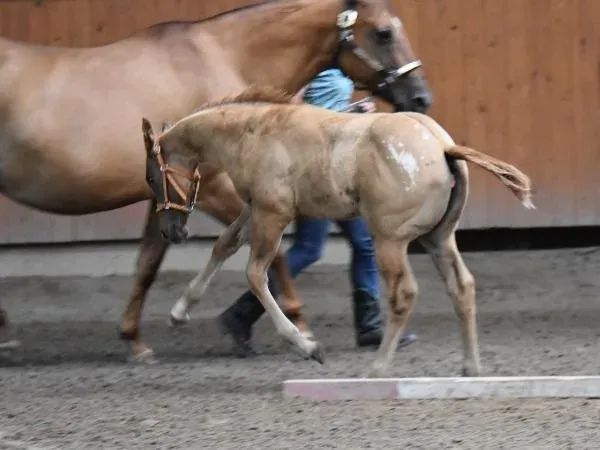
You can spot an Appaloosa from a hundred metres, in fog, from behind. No other horse wears its pattern this openly — and no two patterns are alike. This is the portrait behind the spots: where the breed really comes from, how the patterns appear and disappear, what the character is like, and where to look twice at the vet check.
The breed at a glance
- Origin: north-western USA, bred by the Nez Perce
- Height: mostly 142–163 cm
- Type: stock horse — compact, muscular, agile
- Registry: Appaloosa Horse Club (ApHC), founded 1938, today one of the largest breed registries in the world
- Signature: the leopard-complex gene (LP) — responsible for pattern, mottled skin, white sclera and striped hooves
- Disciplines: all-round western — trail, pleasure, reining, ranch riding, plus an old reputation in endurance
Older than the idea of a studbook
When humans started painting walls, one of the first things they painted was: spotted horses. They have been standing in the Pech Merle cave in France for some 25,000 years — and for a long time the dots were dismissed as artistic licence. Then, in 2011, researchers compared DNA from ice-age wild horses with modern samples and found precisely the gene variant that creates Appaloosa patterns today. The stone-age painters were not fantasising. They were painting portraits.
The modern story begins in the north-west of today's USA. The Nez Perce were among the few indigenous nations to breed horses systematically — with a rigour today's registries would applaud: the best animals stayed in the programme, the rest were sold or traded. The result was tough, sure-footed, enduring horses, many strikingly patterned. Settlers named them after the Palouse River — "a Palouse horse". Over the years, that became a word: Appaloosa.
In 1877 the story nearly ended. In the Nez Perce War the tribe fled under Chief Joseph across roughly 1,800 kilometres towards Canada — on horseback, with families, pursued by the army, over mountain passes you would not ride for fun today. After the surrender, the herds were confiscated and scattered. Centuries of breeding dispersed within a few years.
That the breed still exists is down to a few stubborn people: in 1938, breeder Claude Thompson and allies founded the Appaloosa Horse Club in Idaho and gathered what was left. From a handful of registered horses grew one of the world's largest studbooks. Not a bad second act.
The patterns — no duplicate, anywhere
Behind every variant sits the same gene: the leopard complex, LP for short, plus modifiers that decide how much white a horse gets. The interplay is so individual that no pattern ever repeats — an Appaloosa wears its fingerprint on the outside. The base colour underneath is its own story, told in our colour guide; the pattern settles over any of them.
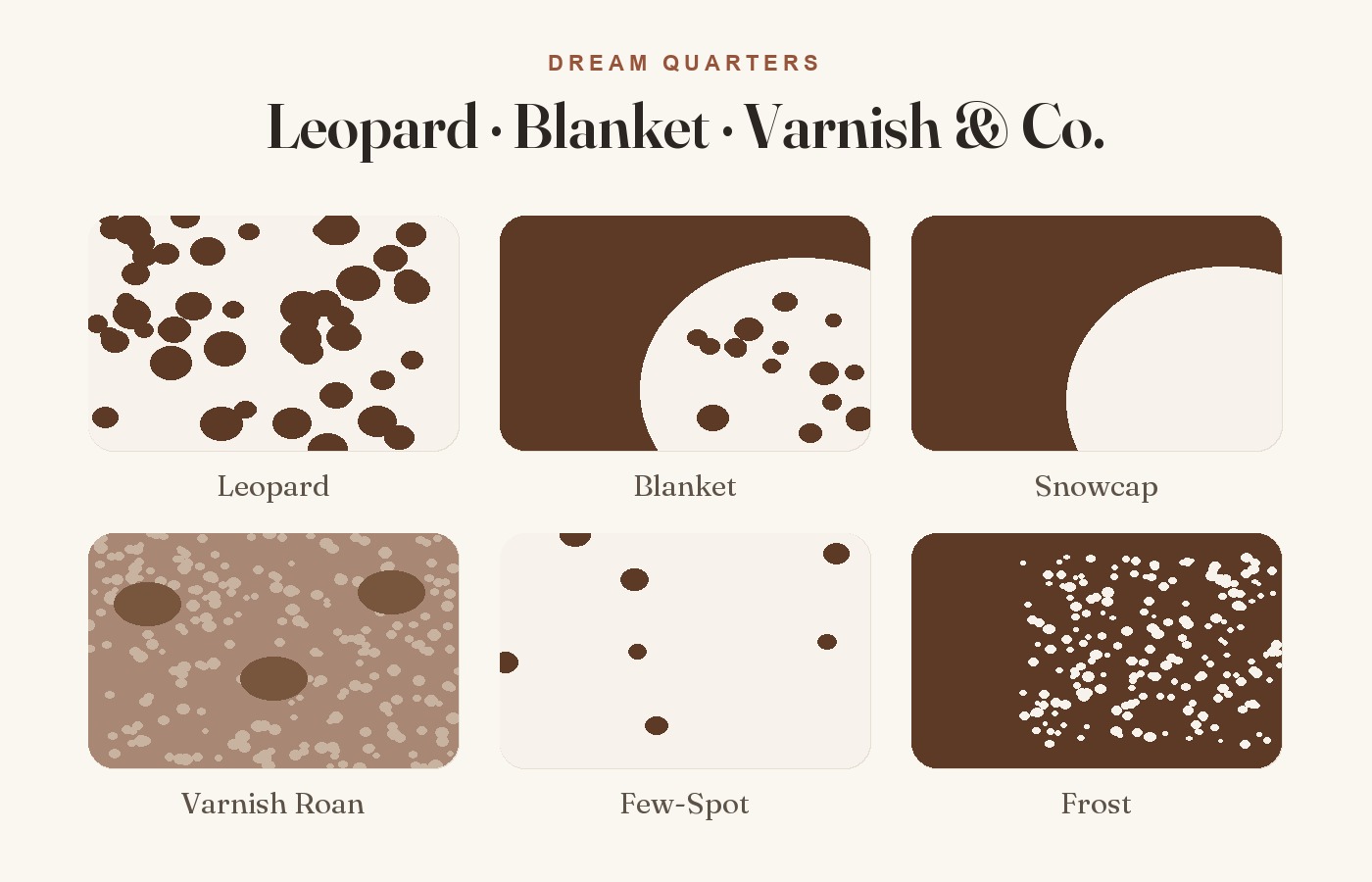
Leopard
White horse, dark spots, everywhere. The breed's poster pattern and the reason phones come out at shows before the horse has done anything at all.
Few-spot
A leopard that left its spots at home — nearly white, with a handful of dots. Genetically interesting: few-spots carry the pattern gene twice and pass it to virtually every foal.
Blanket
Dark horse, white "blanket" over hip and croup, usually with spots inside. The most common pattern on the market and the classic photo from behind-left.
Snowcap
The blanket without spots — clean as fresh snow. Same genetics as the few-spot: double LP, pattern guaranteed in the offspring.
Varnish roan
The only pattern with rolling updates: a varnish roan lightens over years, and only the bony points — nose, cheekbones, hips — keep their dark colour. You buy one horse and get several, visually. If you hate surprises, consider yourself warned; everyone else gets a new profile picture every year.
Frost
White shimmer over the hindquarters, as if someone had dusted icing sugar in moderation. Subtle — by Appaloosa standards.
One quirk that matters when buying: the foal pattern is no guarantee of the final look. Varnish components especially keep shifting for years. Buying an Appaloosa foal always includes a lucky bag — one with good odds, but a lucky bag.
The three markers beyond the coat
The LP gene does not only work on the coat. Three traits belong to the breed like the spots themselves: mottled skin around muzzle, eyes and under the tail, a white sclera — the visible white rim that makes an Appaloosa look at you like a colleague who already knows the punchline — and striped hooves, banded vertically light and dark. Which is why a horse with barely any visible pattern can still be a registered Appaloosa: the markers count, not the show.
Character: a colleague, not an employee
The breed's reputation has stayed remarkably stable across generations: people-oriented, tough, willing — and equipped with opinions. An Appaloosa rarely refuses spectacularly; it politely waits for your proposal to improve. If you like horses that think along, you get a partner for life. If you want an order-taker, you will be re-educated, kindly but firmly.
As always: the individual beats the statistic. Training, raising and daily life turn any breed description into a tendency — visiting, riding and getting to know the horse remains mandatory.
What it is built for
The Nez Perce did not breed a specialist; they bred a horse for everything: long distances, rough country, hunting, daily work. That is still the strength. Appaloosas do trail and ranch riding, go pleasure, some rein and work cattle — and in endurance the breed has an old, earned reputation. It may be the most honest all-round breed in the western world: rarely the flashiest in a single event, very often the most reliable across all of them.
For beginners that means: a well-trained Appaloosa is an excellent first western horse. What "well-trained" means in practice is covered in our guide to learning western riding.
Health: the two honest points
Fundamentally the Appaloosa is a robust horse — its history simply did not let softies through. Two things you must know, and a serious seller raises them unprompted:
- Night blindness (CSNB): horses with a double LP gene — typically few-spots and snowcaps — are night-blind from birth. It is manageable (stables have lights), but you need to know: for keeping, for dusk rides, and above all for breeding. Two patterned parents can produce a double-LP foal.
- Eyes in general: the breed carries an elevated risk of equine recurrent uveitis (ERU, "moon blindness"). No reason to panic — a reason to have the eyes explicitly examined at the pre-purchase exam.
Plus the small matter of pink skin: light patches around muzzle and eyes can sunburn. The solution is the same as for humans and costs a few euros at the chemist.
Is an Appaloosa right for you?
- You want one horse for everything — trails, arena, the occasional show — rather than a specialist.
- You like horses with personality and consider discussions a feature.
- Toughness matters more to you than the last inch of spectacle in a single event.
- And yes: you are fine with being asked about the pattern at the barn. It happens. Always.
Buying an Appaloosa — next steps
Appaloosas are listed far less often than Quarter Horses in the German-speaking market — good ones go fast. What an Appaloosa costs, which questions to ask the seller and how to spot weak offers is covered in the full Appaloosa buying guide. Want to look right away? These are the Appaloosas currently listed — every listing equal, as always. For the breeding side, there is the stallion directory.