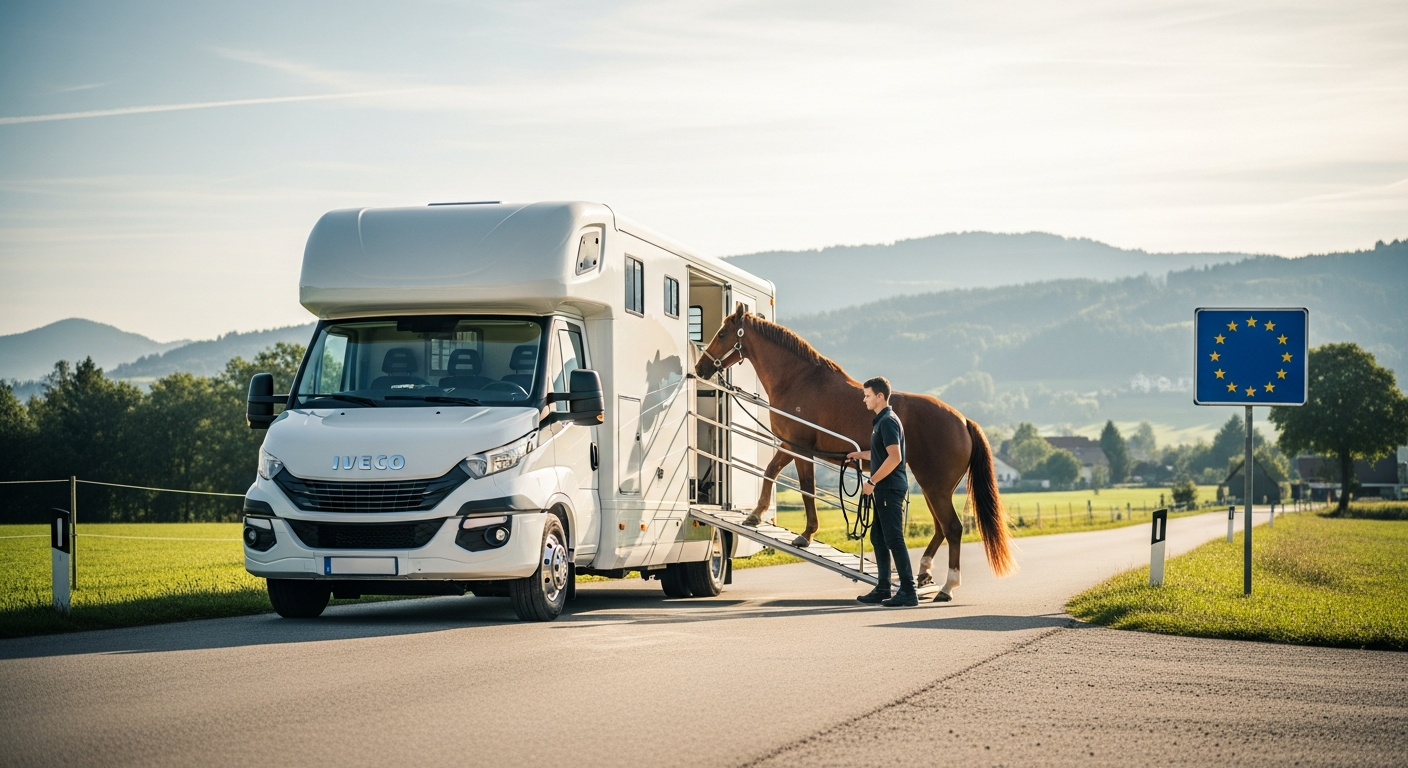
You found your dream horse - but it's in Italy, the Netherlands, or Spain. Now what? This guide walks you through every step of moving a horse across Europe: which documents are non-negotiable, what it really costs, which transport option fits you, and what EU rules apply.
As of May 2026. Regulations change - always check the current rules in both countries before any cross-border transport.
1. Required documents: what you need before the horse goes on the trailer
Without the right paperwork, no serious transporter will move your horse - and at the border it can get expensive fast. These are the documents you must have sorted before the trailer rolls:
- EU Equine Passport - the horse's "ID card." Mandatory throughout the EU, contains identification, ownership history, and vaccinations. Check at the seller's: is it current, are vaccinations recorded, does the microchip number match the horse?
- Bill of sale / purchase contract - written, signed by both parties. The passport alone is not enough proof of ownership in a dispute.
- TRACES certificate (Intra-EU Trade Certificate) - the most important document for cross-border transport within the EU. Issued by the official state vet in the country of origin, no earlier than 48 hours before transport. Allow 5-10 business days lead time.
- Current vaccination record - influenza is required at most facilities, the last shot must be no older than 6 months (sometimes 12). Tetanus and equine herpes (EHV-1) are strongly recommended, mandatory in many stables.
- Transporter's vehicle authorization - commercial transporters must show a valid EU Type 1 (short journeys up to 8h) or Type 2 (long journeys) certificate.
Important: The buyer receives the equine passport in the original at handover. Without the passport, no transport, no boarding, no insurance. Never accept copies.
2. What does transport really cost?
Horse transport is never cheap - but the spread is wide. These ranges help you sanity-check a quote (all prices VAT inclusive, as of May 2026, non-binding):
- Self-pickup with your own trailer (DE↔NL, ~400 km): €150-300 fuel only, plus your time. Requires the right driver's license and an appropriate towing vehicle.
- Shared transport / pooled route (DE↔IT, ~1,200 km): €450-900 - you share the trailer with other horses on a fixed route. Cheaper, but less flexible scheduling.
- Professional door-to-door (DE↔NL/BE): €500-900 for one horse traveling alone.
- Professional door-to-door (DE↔IT): €800-1,500 depending on distance (Northern Italy much cheaper than Southern) and season.
- Professional door-to-door (DE↔ES): €1,200-2,200 - long route, often with overnight stop.
Who pays? Negotiable. Common practice: the buyer pays for transport from the seller's barn onward. The seller arranges TRACES and presents the horse ready to load. Spell this out in the purchase contract.
3. Three transport routes compared
Option A: Self-pickup with your own trailer
- When it makes sense: Distances under 600 km, you know your horse well, have trailer experience, and hold the right license (BE, B96 for trailers over 750 kg, or C1E for heavier combinations).
- Pros: Cheap, full control, no strangers handling your horse. You're there if something goes wrong.
- Cons: You have to assess the loading situation at the seller's barn yourself. If the horse panics or goes lame en route, you're on your own.
- Reality check: Even experienced owners underestimate how exhausting an 8-hour drive with an unfamiliar horse is. For long routes, a pro is often the calmer call.
Option B: Shared / pooled transport
- When it makes sense: Long distance, flexible timing, healthy adult horse with no special needs, tight budget.
- Pros: Significantly cheaper than full-service. Professional drivers know the routes.
- Cons: You share the trailer with other horses. Longer trip due to multiple stops. Schedule follows the route, not you.
- What to ask: How many horses on board? How often do they stop? How are the partitions designed? Conflicts between unfamiliar horses do happen on shared transports.
Option C: Full-service professional transporter
- When it makes sense: High-value horse, young or inexperienced horse, very long route, you want hands-off.
- Pros: Experienced pros, climate-controlled vehicles, in-trailer cameras, EU-certified. Premium operators transport your horse alone or with consistent companions.
- Cons: Highest cost. Reputable operators often need 4-8 weeks of lead time, especially in peak season.
- Established EU operators: Several well-known horse transport companies operate Europe-wide - ask in horse-community forums or your barn manager for first-hand recommendations. We deliberately avoid naming specific companies because service quality and pricing change constantly.
4. Health check before loading
A stressed or sick horse handles a long journey poorly. Sort these points before departure:
- Influenza vaccination - effectively mandatory in the EU for transport. Last shot no older than 6 months; many barns require a fresh shot before first arrival.
- Tetanus - basic protection every 2-3 years. Essential if any injury occurs in transit.
- EHV-1 (equine herpes) - required at most show and breeding barns. Recommended because the virus spreads easily in transport.
- Deworming - done at least 4 weeks before transport, so the horse isn't traveling during active treatment.
- General condition - no fever, no lameness, no cough. When in doubt, postpone by a week.
- Coggins test - normally not required within the EU. Relevant only for transport to/from third countries (UK post-Brexit, Switzerland, USA).
5. Welfare on the road: the EU rules
Horse transport within the EU is governed by EU Regulation 1/2005 ("Animal Transport Regulation"). The most important points for you as a buyer:
- Maximum drive time without break: 8 hours for "short journeys" with a standard trailer. Longer transports require certified vehicles (Type 2) with adequate space, watering systems, ventilation, and mandated rest stops.
- Breaks: On long transports, a water break is mandatory after 8 hours at the latest. After 24 hours, horses must be unloaded, fed, watered, and rested for at least 24 hours.
- Hay and water: The horse should have hay access during transit (hay net) and water at every stop.
- Wraps: Pros often skip them - modern trailers offer enough protection, and wraps can overheat legs in summer. Discuss this with your transporter.
- Heat planning: In peak summer, southbound routes are best done overnight. Some transporters offer "night transport" as a premium option.
6. Special cases: third countries and tricky routes
- Switzerland: Third country, but veterinary agreement with the EU. You need customs clearance (CH is outside the EU single market) and possibly VAT refund on export. Allow half a day extra at the border.
- United Kingdom (post-Brexit): Third country with extensive paperwork - additional health certificates, Coggins test depending on entry point, customs clearance. Transport to/from the UK has become significantly slower and pricier since 2021.
- Southern Italy (Calabria, Sicily): Very long distance from Germany (~1,800 km). Summer heat means climate-controlled transport and night driving. Sicily also requires a ferry crossing.
- Spain and Portugal: Long routes, often with an overnight stop in France. Plan 2-3 days of travel time.
7. Insurance: who is liable when things go wrong?
A lot can happen during transport - a scrape, a lameness, in the worst case an accident. Know these insurance setups:
- Transporter's professional liability: Professional horse transporters carry liability insurance that pays out on proven negligence. Usually covers only a fraction of the horse's value (often €5,000-15,000 flat).
- Your equine third-party liability: Covers damage your horse causes to others - not damage to the horse itself.
- Transit life / health insurance: Strongly recommended for horses worth €15,000+. One-time premium for the duration of transport, covers death and major injuries.
- When does the horse become "yours"? Spell it out in the contract: at handover at the seller's barn? On arrival at your barn? Cleanest practice: risk transfers at loading at the seller's barn - which means you need transit insurance from that moment.
8. Handover checklist on transport day
- Original equine passport in hand and microchip number verified against the horse (transporter or vet brings the reader).
- TRACES certificate copy for your records, original travels with the transport.
- Purchase contract signed by both parties, with date and final payment receipt.
- Visual inspection: general condition, no fresh wounds, no lameness. Ask for a brief lead-out if in doubt.
- Photo or video documentation at loading - protects both sides in any later dispute.
- Final payment only when all the above is verified. Standard practice: deposit upfront, balance at handover.
- Vet contact details at the destination ready to call - if a lameness shows up after arrival, you want to act fast.
Frequently asked questions about horse transport in Europe
How long does horse transport from Italy to Germany take?
Northern Italy (Lombardy, Veneto) to Southern Germany: 8-14 hours of pure drive time, depending on traffic and stops. With a full-service transport this is usually a single-day trip with an experienced driver. Central Italy (Tuscany, Lazio): 14-20 hours, often with an overnight rest stop.
Do I need a TRACES certificate for transport from Austria to Germany?
Yes. Even between EU member states, a TRACES certificate is required for cross-border horse transport. It is issued by the official state vet in the country of origin (Austria, in this case), no earlier than 48 hours before transport.
What does professional horse transport from the Netherlands to Germany cost?
For a single horse, typically €500-900 incl. VAT (as of May 2026, non-binding). Exact cost depends on distance, season, capacity utilization, and service level. Get multiple quotes.
Can I transport my horse across the border myself?
Yes - with a valid EU equine passport, TRACES certificate, and the right driver's license (BE, B96, or C1E depending on trailer weight). You don't need commercial transporter status if the transport is for your own ownership and not commercial.
Who is liable if the horse falls ill during transport?
It depends on when risk transfers under your purchase contract. Typically, risk passes to the buyer at loading at the seller's barn - the buyer should therefore arrange transit insurance. The transporter's professional liability only kicks in for proven negligence.
How far in advance should I book transport?
For reputable operators in peak season (April-September), 4-8 weeks of lead time. In the off-season, 2-3 weeks is often enough. For the TRACES certificate from the official state vet, plan at least 5-10 business days.
Does my horse need to be vaccinated before transport?
Influenza vaccination is effectively mandatory (last shot no older than 6 months). Tetanus and equine herpes (EHV-1) are strongly recommended; many barns require them on arrival. Deworming ideally 4 weeks before transport.
The bottom line: plan well, ride easy
Horse transport in Europe is very doable - but it requires planning. The three things to nail:
- Paperwork first: equine passport and TRACES certificate are non-negotiable. Allow at least two weeks of lead time.
- Choose your transport option honestly: self-pickup isn't always best, only cheapest. For long routes or valuable horses, the pro is worth it.
- Sort insurance: who carries the risk from when? Spell it out in the contract.
Get those three right and the transport becomes a calm affair - and your new horse arrives healthy and low-stress. Good luck on the way to your dream horse!
"The horse is only yours when it stands quiet in your barn." - old riding saying