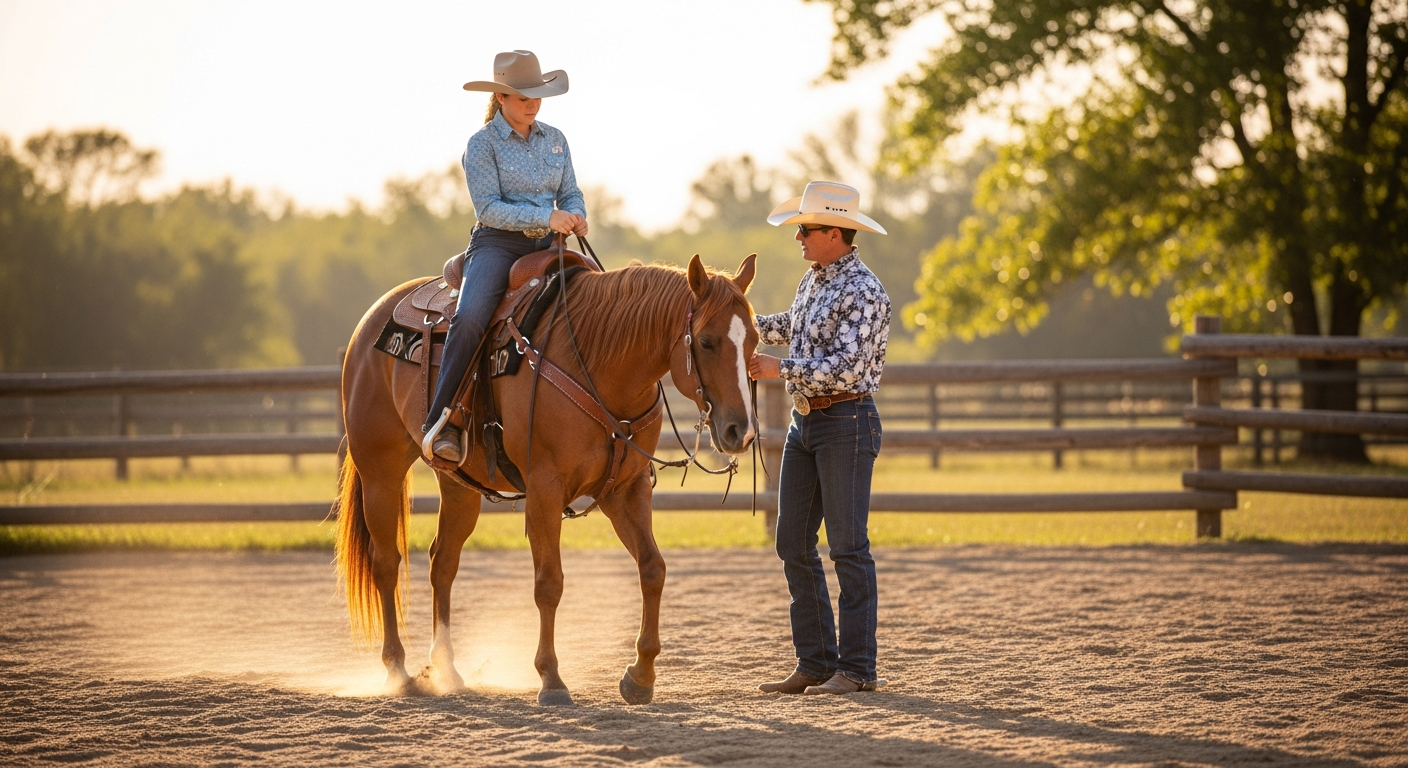
A great western riding course can do more for your riding in three days than six months of solo practice. Whether you're sitting in a western saddle for the first time or preparing for your first competition, the right course with the right instructor accelerates your progress faster than almost anything else. But the market is crowded and hard to navigate. This guide cuts through the noise.
What Types of Western Riding Courses Are There?
Before you book, it helps to understand what different formats actually deliver — because a day workshop and a multi-day camp are very different experiences.
Day Workshop / Day Course
Typically 4 to 8 hours in a single day. Ideal for beginners getting a first taste of western riding or for riders who want to work on one specific topic — trail fundamentals, basic horsemanship, collection basics. Advantage: accessible and low-commitment. Limitation: not enough time to make deep changes in more complex skills.
Weekend Clinic
The classic western riding format. Saturday and Sunday, usually 6 to 8 hours each day, often with a fixed group of riders. The extra day allows concepts from Saturday to settle overnight, then be refined and built upon on Sunday. Ideal for intermediate riders working on discipline-specific skills: reining manoeuvres, speed control, ranch riding transitions.
Multi-Day Camp
Spanning 3 to 7 days, camps offer the most intensive learning environment. Often include accommodation for horse and rider, evening theory sessions, and a tight-knit community of riders with the same goals. For many riders, a well-run camp is the single biggest turning point in their development — not because of the volume of riding, but because sustained focus on one goal over several days creates a depth of change that shorter formats simply cannot.
Online Course
Video courses, live webinars and video-call coaching sessions have established themselves over recent years. Excellent for theory, training plans, and horsemanship principles. Not a substitute for in-person riding instruction, but a valuable complement — especially for riders in rural areas with limited access to qualified trainers.
Choosing the Right Level
The most common booking mistake: choosing a course based on interest rather than current ability. A beginner in an advanced reining clinic learns little and disrupts the group. An experienced rider in a foundations course gets bored and wastes money. Be honest with yourself — and if you're unsure, contact the organiser and describe your background.
Beginners (0–2 years western riding)
Look for courses explicitly marketed as beginner-friendly, covering: basic aids and body position, walk/trot/lope on a straight line, simple leg yields, horse behaviour and ground handling. Check whether the course requires your own horse or whether school horses are provided.
Intermediate (3–8 years western riding)
This is where discipline-specific training pays off. Narrow your focus: reining, ranch riding, trail, western pleasure, or cutting. Ensure the instructor has verifiable credentials in your chosen discipline — an outstanding reining trainer is not automatically a good trail instructor.
Competition Preparation
Competition prep courses should train specific patterns, be grounded in how judges score, and give riders honest, detailed feedback on where they stand. Ask whether the trainer has personal competition experience and whether they actively accompany students to shows.
What to Look for in a Course Listing
A well-written course listing tells you a lot — including what the organiser is hiding by not mentioning it. Key points to check before booking:
Trainer Background and Credentials
What is the trainer's background? Do they have competition results in the relevant discipline? Are there testimonials from past participants? A trustworthy organiser names their credentials openly and welcomes questions.
Group Size
Too many riders means too little individual attention. For mounted work, 4 to 8 riders per trainer is the practical ideal. For groundwork or horsemanship sessions, slightly larger groups can work. Always ask how many spots are available.
Your Own Horse or School Horse?
Many courses require participants to bring their own horse; others provide school horses. If you don't have a horse or need to travel a long distance, this matters. Also check whether the venue provides stabling or paddock space, and what the additional cost is.
Arena Surface and Facilities
Well-maintained sand footing is the western riding standard. Hard, uneven, or poorly maintained surfaces are a welfare issue for horses and a safety issue for riders. For outdoor arenas, ask what the backup plan is in poor weather.
Accommodation and Catering
For multi-day courses: Is overnight accommodation available on site? Are meals included or available nearby? What does a stable or paddock space for your horse cost? All of this should be clearly stated in the listing.
Cancellation Policy
The most underrated detail. What happens if you fall ill? Can you transfer your spot to another rider? Is there a waitlist? A reliable organiser has a clear, fair cancellation policy in place — and refunds at least a portion of the course fee for illness-related cancellations.
Questions to Ask Before You Book
Don't hesitate to contact the organiser directly. A quick, clear response is already a good sign in itself.
- What exact level is this course designed for? What does that mean in practical terms?
- How many riders will participate?
- How many riding hours are planned per day? How long are breaks?
- Can I bring my own trainer or a support person?
- Will riding sessions be filmed? (Hugely helpful for review and practice at home)
- What is the wet weather contingency?
- What are the cancellation terms?
- Can you put me in touch with a previous participant?
Typical Pricing in Germany, Austria, Switzerland and Italy
Prices vary significantly by trainer reputation, duration and region. Here's a country-by-country breakdown:
Germany and Austria
Germany and Austria have the densest concentration of western riding courses in the German-speaking world. Typical price ranges:
- Day workshop: €80–180 per person (usually excluding stabling fees)
- Weekend clinic: €180–400 per person for two days
- Multi-day camp (5–7 days): €400–900 including accommodation, often excluding horse stabling (€30–50/night)
- Well-known international trainers: €500–800 for a single weekend — justified when the quality is genuinely exceptional
- Online courses: €30–200 depending on content and format
Switzerland
Switzerland's general cost of living pushes course prices noticeably higher than the German market. A weekend clinic typically runs CHF 250–500; multi-day camps with accommodation can reach CHF 1,200–1,500. The quality is often excellent — the Swiss western riding community is tight-knit and selective about who gets platform.
Italy
Italy's western riding scene is growing rapidly, particularly in northern regions (South Tyrol, Lombardy, Piedmont) and Tuscany. Day courses typically run €70–150, weekend clinics €180–380. Camps are especially popular in Italy because many venues combine riding with attractive rural accommodation — often at lower price points than the German-speaking market. South Tyrolean providers frequently operate bilingually (German and Italian), making them accessible to riders from both language communities.
Across all markets: always weigh price against demonstrated quality. A cheap course with a poor instructor costs you more in the long run than a well-priced course with an outstanding one.
How to Prepare for a Course and Get the Most Out of It
The quality of a course depends not only on the instructor — your own preparation plays a significant role in how much you take home.
Before the course
Think about what you specifically want to work on or improve. Write down two or three questions you want to ask the trainer. If you're bringing your own horse, make sure it is fit, relaxed about transport, and used to working in unfamiliar environments. For camps, ride a little more regularly in the weeks beforehand so neither you nor your horse arrives exhausted from day one.
During the course
Listen carefully when the instructor corrects other riders. You learn just as much from watching others as from being corrected yourself. Take notes between sessions — not while riding, but during breaks or in the evening. Ask questions when something is unclear: a good trainer welcomes them; an unreliable trainer deflects or dismisses them.
After the course
The most important work happens after the final day. Review your notes and pick one or two things to actively practise over the following weeks. One well-implemented improvement is worth far more than ten concepts forgotten within a week. If video footage was captured, watch it together with your regular trainer at home — the outside perspective often reveals things you couldn't feel from the saddle.
Gear and Equipment to Bring
Even if you're riding a school horse, the right gear makes learning safer and more effective.
- Western safety helmet: Non-negotiable — regardless of experience level. Many venues require it by policy.
- Western boots with a heel: Prevents the foot from sliding through the stirrup
- Long riding trousers: Avoid thick-seamed jeans — they cause painful chafing over hours in the saddle
- Gloves: Useful for groundwork and longe work
- Notebook: Old-fashioned but invaluable — after an intensive riding day, you'll forget half of what you learned without notes
- Water bottle: Hours in the saddle, often in the sun, is physically demanding
If you're bringing your own horse: pack enough feed for the full duration, the vaccination passport (often required), and all your usual tack. Some trainers have specific equipment requirements — ask in advance.
Red Flags to Take Seriously
Not every course organiser meets the same standard. These warning signs are worth taking seriously:
- No clear information about the trainer: Who is actually teaching? Without a name and verifiable background, there's no basis for trust.
- No cancellation policy: An organiser without cancellation terms is protecting only themselves, not participants.
- Unlimited participant numbers: A course with 20+ riders and one trainer is a spectacle, not instruction.
- No response to questions: An organiser who ignores or deflects questions before the course will be equally unreliable during it.
- Exaggerated promises: "From zero to sliding stop in one weekend" — it doesn't work that way.
- No visible concern for horse welfare: Watch how the instructor treats the horses. Forced, harsh, or rushed work with animals is a dealbreaker.
Where to Find Reliable Western Riding Courses
On Dream Quarters you'll find a growing selection of western riding courses, clinics and camps across Germany, Austria, Switzerland and Europe. Listings include trainer background, dates, pricing, level requirements and direct contact options — so you can make an informed decision before booking.