Take your horse's papers and count the letters in its name, spaces included. You will get to 20 at most. Not because breeders are short of words, but because the largest studbook in the world has a rule that squeezes every name into the same line. That rule has produced a language of its own – Lil instead of Little, N instead of and, Docs without an apostrophe – and it explains, in passing, why the most successful reining sire in history needs a nickname.
The rule: 20 characters, and the space counts
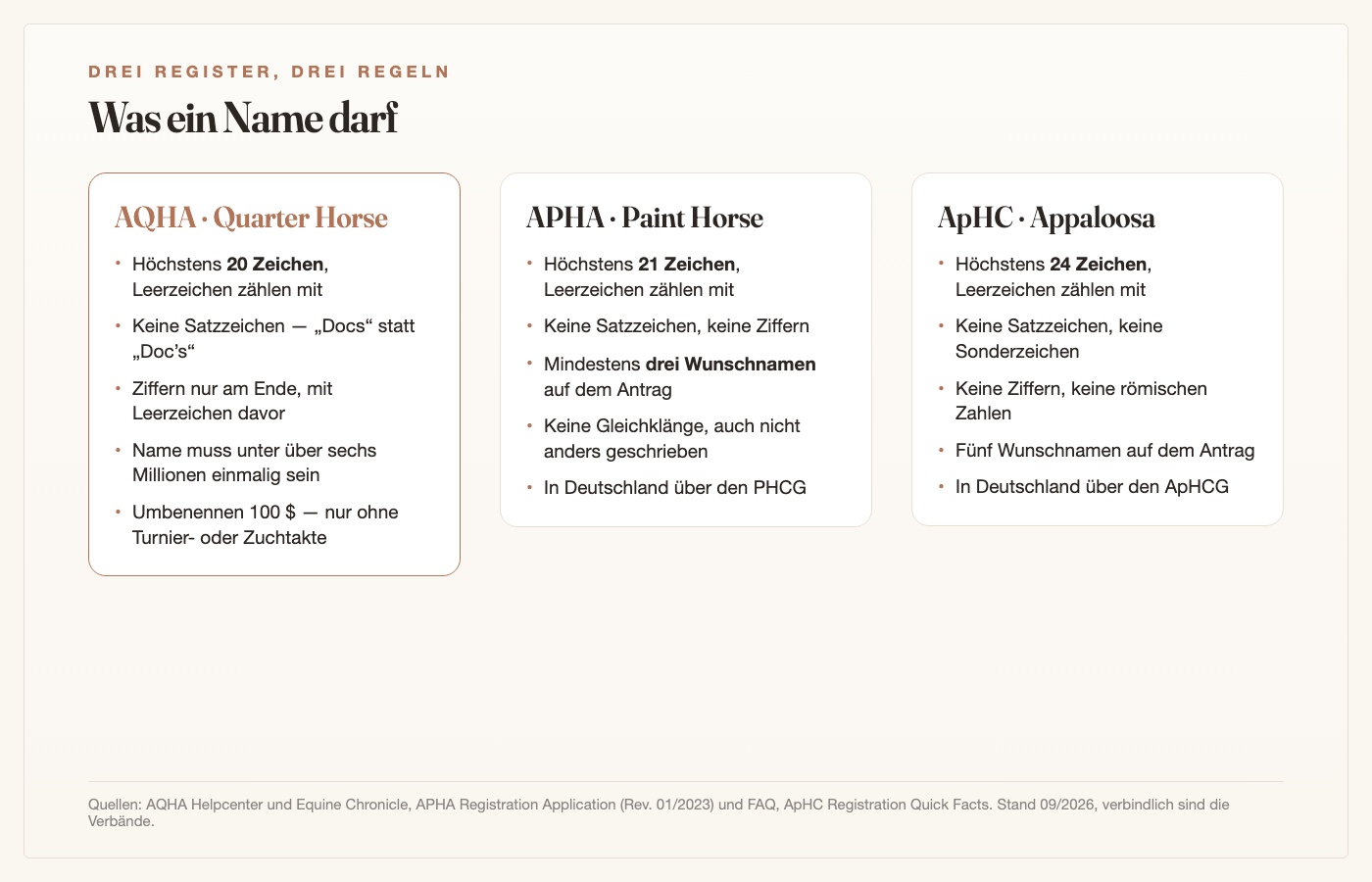
The American Quarter Horse Association (AQHA) has been registering horses since 1940 and entered its six millionth in May 2020. Each carries a name that may only be given once – and that has to fit into a line of at most 20 characters, spaces and numerals included. Punctuation is not permitted: no apostrophe, no hyphen, no full stop. Numerals may only stand at the end, with a space before them. The name should, in the association's words, be kept clean and in good taste, and anyone wanting to name a foal after a celebrity needs that person's written permission. Whether the name has anything to do with the pedigree is entirely up to you.
The same applies to German-bred Quarter Horses: the Deutsche Quarter Horse Association (DQHA) keeps the studbook in Germany, registration itself runs through the AQHA in Amarillo, and the certificate in your hand is an American one. So the 20-character line applies too. Members can check online before applying whether a name is still available; among six million names, that is no formality.
How a rule invents a language
Give someone 20 characters and three ancestors to fit in, and they start saving. Little becomes Lil, and becomes a single N, Checks becomes Chex, Gonna becomes Gunna – and suddenly there is a Gun in the name. Anyone who needs uniqueness doubles a letter: Sixxsilver, Nixxon, Whizzabelle. Numbers are spelled out because numerals may only stand at the end, which is why a horse is called Eighty Six rather than 86. And the apostrophe that still appears in older papers – Doc O'Lena, Jewel's Leo Bars – has disappeared: today it is Docs Hidden Chic and Peptos Stylish Cat.
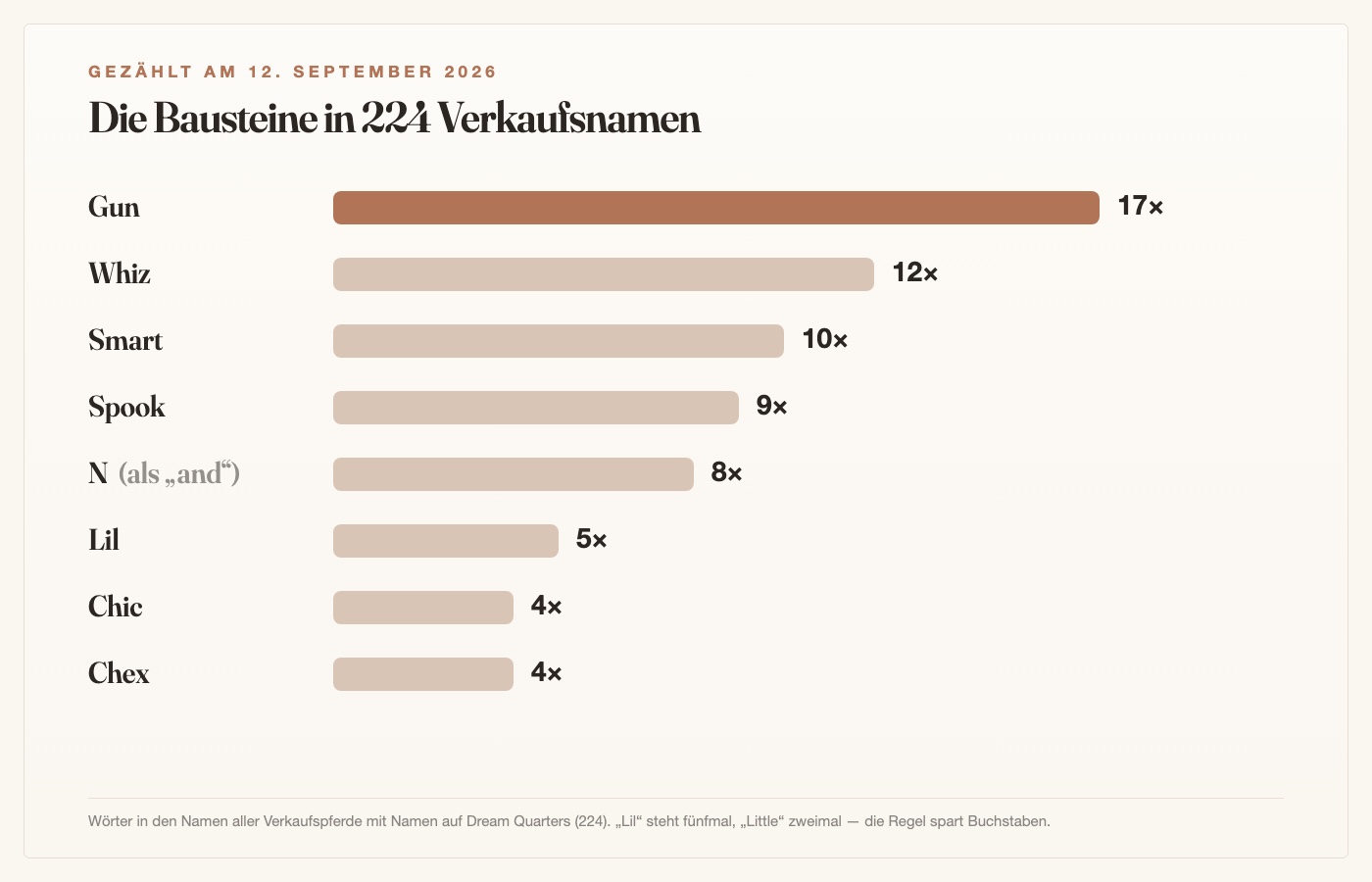
You can see how strongly the rule works on our own market. Of the 224 sale horses with names on Dream Quarters, the average name uses 17 characters; 32 names use exactly 20, and almost one in three sits at 19 or 20. The N for "and" appears eight times, Lil five times, Little only twice. And if a breeder drops all the spaces, a whole sentence fits: Maytheforcebewhizyou, 20 characters, no room to breathe.
The farm code up front
64 of our 224 names begin with two or three capital letters: SL, UG, DR, OK, GSR, VQH. That is the breeder's code, the brand on the paper. It makes the name unique, tells insiders at a glance which barn the horse comes from – and it costs three of the 20 characters. Anyone using a code has only 17 left for the actual name. Which explains why a farm code is so often followed by a single strong word rather than half a pedigree.
Colonels Smoking Gun: exactly 20
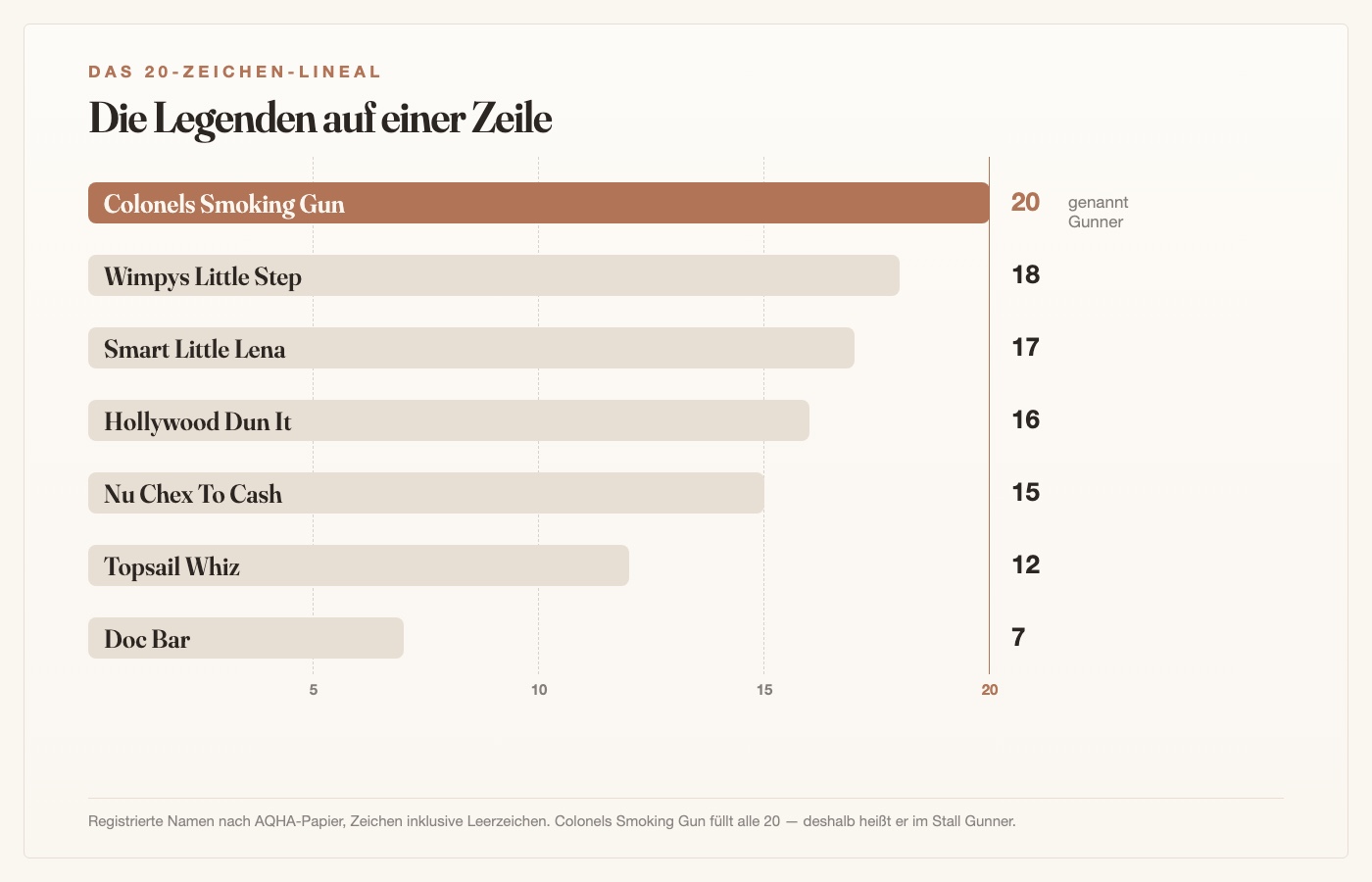
The most famous names in the sport are surprisingly short – and the most famous of all fills the line to the last character. Colonels Smoking Gun, the most successful sire in the history of reining, has exactly 20. Not one more would fit, which is why nobody uses his full name: he is Gunner. Wimpys Little Step comes to 18, Smart Little Lena to 17, Hollywood Dun It to 16, Nu Chex To Cash to 15, Topsail Whiz to 12. And Doc Bar, the stallion who founded the modern cutting and reining horse, needed seven.
A name is forever, almost
What is once written on the papers can only be changed under conditions. The AQHA allows a name change only as long as the horse has never competed at an association show, never started in a race, never received an award and never appeared on a breeding document – for 100 dollars, 155 for non-members. After the first start the name is fixed. And a name only becomes available again if the horse has been reported dead, never competed, holds no award and has no offspring that count. That is why there will never be another horse called Colonels Smoking Gun – and no second Smart Little Lena. The legends' names are taken for good.
How tight the line feels is shown by a petition from 2024 asking the association to raise the limit. It collected 149 signatures. The line stayed at 20.
Paint Horse and Appaloosa: different lines, same idea
For the Paint Horses of the APHA the line is one character longer: 21, spaces included, with no punctuation and no numerals. The application asks for at least three name choices, and the association rejects soundalikes – a name that sounds like one already taken is refused even if it is spelled differently. If you want to secure a name, you can reserve it for twelve months for a fee. In Germany this runs through the Paint Horse Club Germany (PHCG). At the Appaloosa Horse Club (ApHC) the line is a little longer: 24 characters including spaces, but no punctuation, no special characters, no numerals and no Roman numerals – and five name choices on the application. In Germany the ApHCG is in charge.
What this means for your horse
First: the name on the papers is the only one that counts. Enter it in your listing exactly as written, not the barn name – our sire pages link listings through the registered names of sire and dam's sire, and one typo separates your horse from its half-siblings. Second: names are search terms. Type a word like Whiz or Gun into our search and you will see every horse carrying it. Third: when you name a foal, count, check availability, and drop the apostrophe before the association does.
What the building blocks you use actually mean – Gun, Whiz, Dun It, Smart – is explained in the guide reading reining bloodlines; where the breed's own name comes from, in the guide about the quarter mile. Every route around the papers, from transfer of ownership to foal nomination, is on the papers page, and the stallions behind the names on our sire pages. And how many characters your horse has, you now know for yourself.