Scroll through the horses for sale and read nothing but the sire names. Gun. Whiz. Dun It. Shine. Spook. The same syllables, over and over, listing after listing. That is not coincidence and it is not marketing — it is a pedigree hiding inside a handful of names. And if you follow it, it leads somewhere almost nobody bothers to look: to the mares.
The names are a pedigree — and they point the wrong way
No rule anywhere says a reining foal has to carry “Gun” or “Whiz” in its name. All the AQHA requires is that a name run no longer than 20 characters, spaces included, with no punctuation and no close resemblance to a name already on the books. The rest is custom — and a very practical custom at that: a short syllable costs almost nothing out of those 20 characters and gives away the breeding in a sale catalog or on the draw before anyone opens the papers.
The interesting part is where those syllables actually come from. Almost everyone assumes they trace back to the famous stallion they sound like. Usually they don’t:
- “Whiz” did not start with Topsail Whiz. He got it from his dam, Jeanie Whiz Bar — and then handed it on.
- “Gun” did not come from Colonels Smoking Gun. His sire was Colonelfourfreckle. The syllable came from his dam, Katie Gun.
- “Chex” is older than Nu Chex To Cash — it reaches him through his dam Amarilla Chex, out of the Bueno Chex family.
- “Wimpy” in Wimpys Little Step is no nod to his sire. That would be Nu Chex To Cash. The syllable comes down the dam’s side, from Wimpy Leo.
So the origin of these syllables sits mostly on the dam’s side — only with Hollywood Dun It and Shining Spark does the syllable genuinely begin with the stallion it gets credited to.
They spread through the stallions, though, for a very plain reason: a sought-after stallion gets a hundred foals in a season, a mare gets one. Which is why the syllable in a listing today usually sits with the sire — in a sample of 153 listings from our own catalogue, roughly six times out of ten, against three for the dam. The mares gave the name. The stallions took the fame.
And then there is the finest contradiction of the lot: “Gunner” is not a registered name at all. The AQHA knows the stallion as Colonels Smoking Gun. Gunner was his barn name. Every horse walking around today with “Gunner” in its papers is tipping its hat to a nickname.
Katie Gun: the mare who made history twice
In 1987 a bay mare hits the ground on an American breeding farm: Katie Gun, by John Gun out of Bueno Katie. She was no footnote herself — 68.5 AQHA points, a Superior in reining, 1990 AQHA Reserve High-Point Reining Horse. A mare who could do the thing she would later pass on.
Then comes what makes her name immortal. She produces two sons by two different sires — and both turn into million-dollar sires themselves:
- Colonels Smoking Gun (“Gunner”), 1993, by Colonelfourfreckle
- Spooks Gotta Gun, 2002, by Grays Starlight — half-brother, nine years younger
Two stallions, one and the same dam, two different sires. The reining world knows both names; hardly anyone knows the mare standing behind them. Her offspring have earned more than $645,000 between them, and she sits among the top ten NRHA producers.
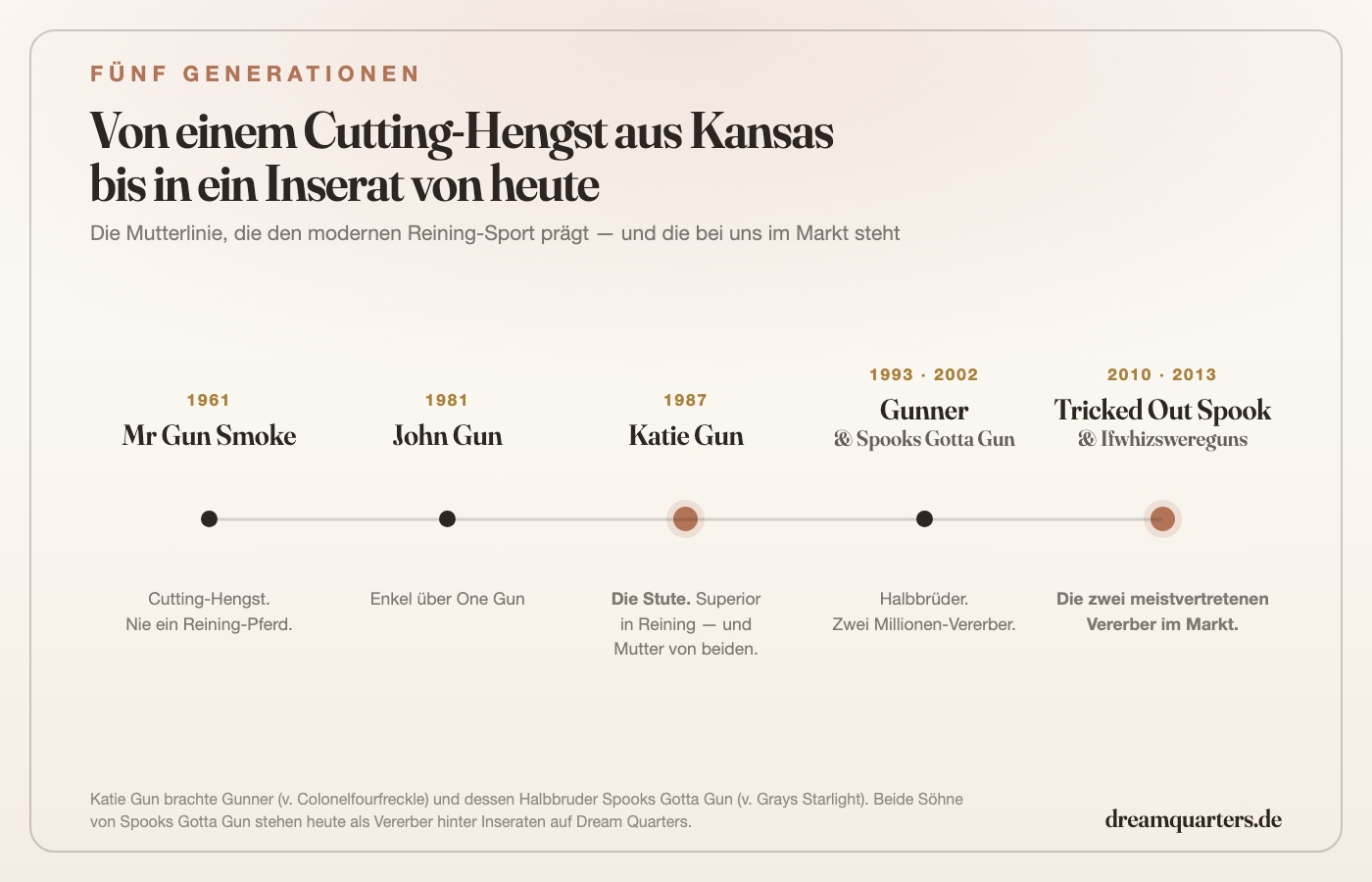
Here is where it gets concrete for you as a buyer. The two most heavily represented sires in the current offering on Dream Quarters are Tricked Out Spook (2010) and Ifwhizswereguns (2013). Both are sons of Spooks Gotta Gun. Both, therefore, grandsons of Katie Gun — which makes them nephews of Gunner. Five generations, from one mare in the United States to a listing you can open tonight.
Gunner: the stallion who never heard a word
If any horse has ever earned its place on a T-shirt, it is this one. Colonels Smoking Gun, foaled in 1993, was impossible to miss: a sorrel with splashed white markings, ice-blue eyes, a completely white face, four white legs, a white tail — and floppy ears the sport is still grinning about. You could pick him out from the far end of the arena.
Two things about him are genuinely remarkable, and both get told wrong almost every time.
First: he was not a Paint Horse. Both parents were AQHA-registered. The only reason his breeder could not register him with the AQHA was that the rulebook of the day would not allow that much white — so he went to the APHA instead, as Colonels Smokingun. Not until the AQHA scrapped that rule in 2004 did he get his AQHA papers. He was never a Paint. He was a Quarter Horse the rulebook refused to let in.
Second: he was deaf. That comes with splashed white genetics — the APHA uses him as an example of the pattern in its own guide to coat color genetics. A reining stallion who never once heard his own whoa before a sliding stop. Trainers who work with his deaf offspring do not describe it as a handicap: the horses are more focused, because they hang on the rider instead of the voice — and the rider, for once, actually has to ride.
In the show pen the one big title stayed out of reach: at the 1996 NRHA Futurity he finished Reserve Champion, beaten by half a point. In 2003 he went into the NRHA Hall of Fame. As a sire he became the thing the sport measures him by today — and in 2025 it was his own son Gunnatrashya, of all horses, who knocked him off the top of the all-time sire list as the NRHA’s first $16 million sire.
Hollywood Dun It: the runner-up who finished first
In 1986 a trainer named Tim McQuay rides a three-year-old dun into the NRHA Futurity and comes out — second. Not first. That matters, because sale ads still claim to this day that Hollywood Dun It won the Futurity. He never did.
What happened afterward is the actual story. At that point McQuay was only the hired rider. It was after that second-place finish that he and his wife Colleen bought the horse. In 1987 the stallion took the Derby and the Superstakes, both Open. His own earnings stayed modest, at $65,808.
As a sire he turned into an institution: NRHA Hall of Fame in 2000, the first stallion ever to pass three and then four million dollars in offspring earnings. And in 1998 he became the first reining horse in history to be made into a Breyer model — a knighthood, in an industry where children’s bedrooms count as their own currency.
When he died in 2005 at the age of 22, Colleen McQuay said something anyone who has ever had to let a horse go will recognize: she did not know whether she would ever be able to bear putting another horse in that stall.
His sire, Hollywood Jac 86, deserves a footnote of his own. A palomino foaled in 1967, ridden to the NRHA Non-Pro world championship in 1974 and 1975 by a Chicago businessman named Richard Greenberg — an amateur, on a horse that would later become the NRHA’s first million-dollar sire. And no: the “Hollywood” did not come from his sire. That was Easter King. It came from his dam, Miss Hollywood, a daughter of Hollywood Gold. Here too, the name points at the mare’s side.
Mr Gun Smoke: a cutting horse at the root of all of it
At the very start of this chain stands a horse that was never a reining horse at all. Mr Gun Smoke, foaled in Kansas in 1961, a sorrel, by Rondo Leo out of Kansas Cindy. His entire competitive record is cutting: 71 AQHA points, a Superior in cutting, $8,476 in NCHA earnings. No reining career. Not one start.
He made the NRHA Hall of Fame regardless — in 2008, on the strength of what his offspring did. The best anecdote belongs to the man who bought him: Dale Wilkinson, the one they call the father of reining, winner of the very first NRHA Futurity in 1966 and, in 1986, the first person ever inducted into the NRHA Hall of Fame. He picked the stallion up in the sixties — for $2,500, a trophy and a mare. Then he showed him in cutting, essentially as advertising for the breeding shed. Hence the Superior.
And from that cutting horse a straight line runs into every other modern reining pedigree: Mr Gun Smoke → One Gun → John Gun → Katie Gun → Gunner. The syllable “Gun” travels four generations down the female line before it finally sticks to a stallion everybody can name.
The honest part: a name is a clue, not proof
As enjoyable as the naming game is, it must not be the thing that steers your purchase. Three limits worth knowing:
- The syllable tells you nothing about distance. A “Whiz” in the name can mean sire, grandsire, great-grandsire — or a mare four generations back. Four generations out, a famous name is statistically close to meaningless.
- It is not protected. Nothing stops a breeder from using a well-known syllable simply because it sounds good. There is no one checking.
- The best horses often carry none at all. Down Right Amazing, the horse that pushed Gunner past the $15 million mark, has no “Gun” in his name. Smart Spook, the most successful son of Smart Chic Olena, carries no “Chic”. A missing building block tells you precisely nothing.
Which makes the rule a simple one: the name is the way in, the papers are the proof. Ask to see the registration papers, read the first two generations properly — and treat everything behind that as family history rather than a reason to buy. How to read papers in general is covered in the bloodlines guide; what else matters when you are buying a reining horse is in our guide to buying a reining horse.
How to read all this in a listing
Once you know this, the search turns into a different kind of tool. You can search for name components instead of individual stallions — and pull up entire families in one go:
- Everything with “Gun” — the Katie Gun family and everything hanging off it
- Everything with “Whiz” — the Topsail Whiz line
- Everything with “Dun It” — Hollywood Dun It and his descendants
- Everything with “Shine” — the Shining Spark corner
If one particular sire is what you are after, there is a more direct route. The sire directory lists every stallion with offspring currently on the market — with the matching listings behind each one. The details come from the sellers’ own listings, not from outside databases; we do not copy out anyone’s pedigree database.
What is actually standing here right now
To finish, the acid test. Of the sires whose offspring are currently listed with us, more than half carry one of these name components. Ten of them manage two lines in a single name — Gunner Dun It Again ties Gunner and Hollywood Dun It together in four words, and Ifwhizswereguns is a pun that squeezes in Whiz and Gun at the same time. His sire is Spooks Gotta Gun, his dam is called Ifwhizsweredollars. Even the groaner follows the female line.
So the next time you scroll through the horses for sale, try reading the sire names as a piece of text. You will start recognizing the same four or five families — and with some horses it will dawn on you that behind the name in the listing stands a mare who was foaled in Kansas or Oklahoma forty years ago. For the breeding side there is the stallions-at-stud directory; and if you want to know why these same lines sit at the front in ranch riding too, the answer is in the ranch riding guide.