Quarter is not a quarter of anything. Not a quarter Thoroughbred, not a quarter Arabian, not a breed quota. Quarter is a distance: a quarter of a mile, 440 yards, once down the village street. Your Quarter Horse has almost certainly never run it – and is built for exactly that all the same. And if you read its papers back to the fifth generation, you will find a racehorse there that earned 95 dollars in its entire career. The story behind it begins in 1674.
Virginia, 1674: two horses, one village street, one weekend
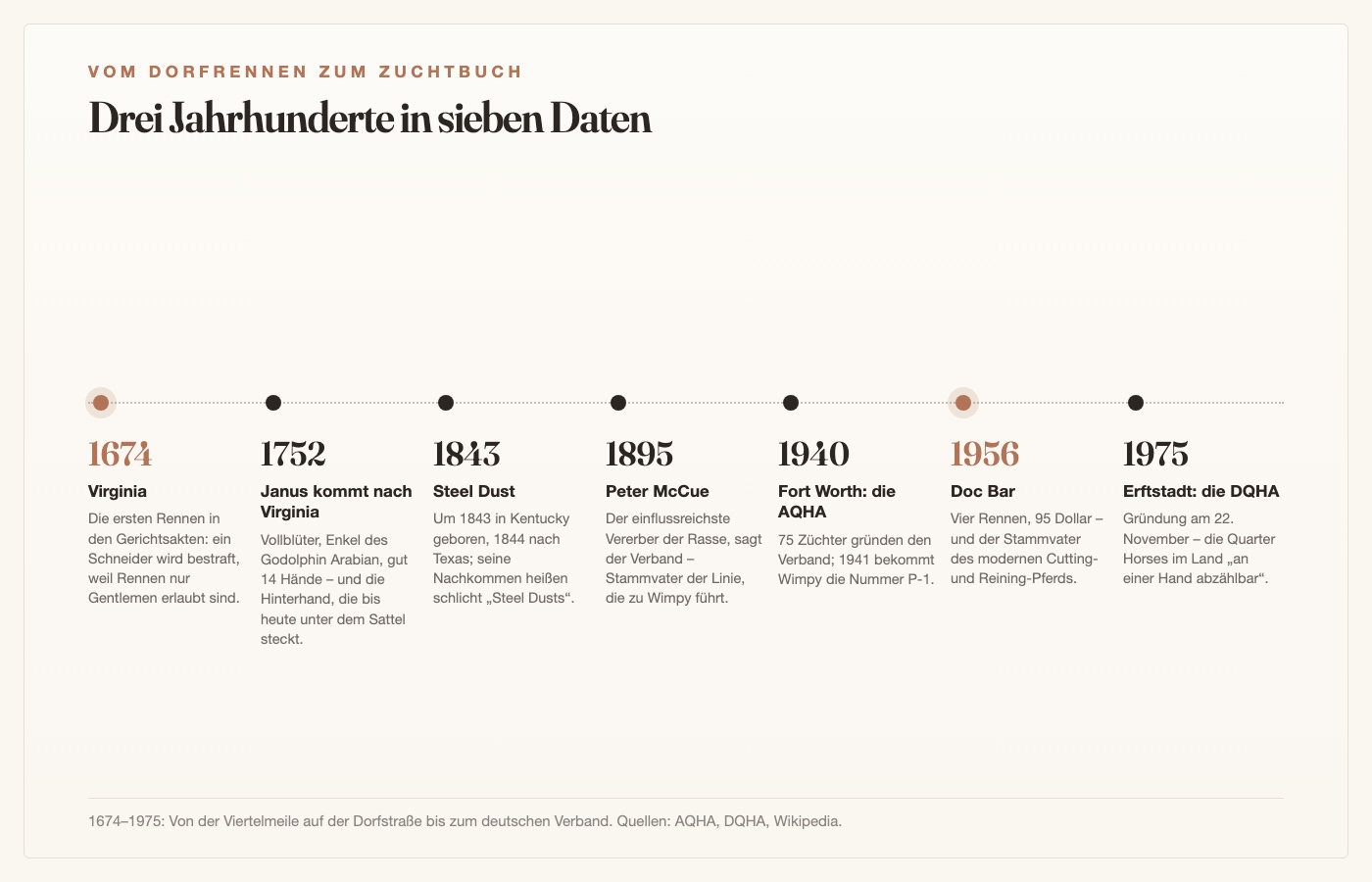
The first races on court record were run in 1674 in Virginia – on record because a tailor from York County was fined: racing was for gentlemen only. A few years later, quarter-mile races are documented in Henrico County. There was no racetrack, so people used what they had: the road through the village, a clearing, a farm track. They raced on "quarter paths", straight lanes or stretches of road a quarter of a mile long – 440 yards – always two horses against each other. As the association tells it, the animals were first called "Quarter Pathers", later, more grandly, "Celebrated American Quarter of a Mile Running Horses". It took another two hundred years before that became the two words printed on every registration certificate today.
The betting was reckless. By around 1690, so the story goes, whole plantations were changing hands because one horse was a single street faster than another. And because the races were short and could be run anywhere, nobody needed a racehorse in the modern sense – they needed one that pulled the plough on weekdays and left the neighbour behind on Saturday. If that sounds familiar – the everyday horse that goes to a show at the weekend – you have understood the Quarter Horse before it had a name.
The recipe was a cross: the settlers' English horses on the small, hardy Chickasaw horses of the Southeast, themselves of Spanish descent. In 1752 came the decisive ingredient. Janus, an English Thoroughbred and grandson of the Godolphin Arabian, was brought to Virginia – lame, the story goes, and yet he raced again over there. A good 14 hands, big-boned, with hindquarters that did not quite fit the rest of him. Those hindquarters are what you sit on today.
Steel Dust: from racehorse to cow horse
For two hundred years it stayed that way: fast over a short distance, useful on every other day. Then the breed turned west. Steel Dust, foaled in Kentucky around 1843 and taken to Texas the following year, became so famous there after beating a favourite called Monmouth that his descendants were simply called "Steel Dusts". The whole breed was very nearly named after him – more on that in a moment.
In Texas it turned out that a horse that explodes from a standstill can do something besides win: it can cut off a cow. After the Civil War the big ranches drove their herds north, and the horse that suited the job was the compact sprinter with the cool head. The weekend racer became a working tool, and the working tool became the breed we know. Peter McCue was foaled in 1895 – in the American association's view the most influential sire the Quarter Horse has ever had. His line leads straight to the first horse ever to receive registration papers.
Fort Worth, 1940: 75 men and a name that was almost different
On March 14 and 15, 1940, 75 breeders and ranchers met in Fort Worth, Texas, and founded the American Quarter Horse Association. The name was not settled from the start. One proposal was "American Steel Dust Association" – after the stallion from Kentucky. They chose the distance over the horse. That is why your horse is named after 440 yards and not after Steel Dust.
The young association did not hand out the first number in its studbook by age or merit but by competition: whichever stallion won grand champion at the 1941 Southwestern Exposition in Fort Worth would get P-1. It was Wimpy, a King Ranch stallion, a grandson of their foundation sire Old Sorrel on both sides. The association has been counting ever since: on May 19, 2020 it registered its six millionth horse. No other studbook in the world is bigger – and every AQHA certificate you hold continues a sequence that began in 1941 with a horse called Wimpy.
440 yards in 20 seconds
The best way to see what the quarter mile made of the horse is what it can still do today when allowed. The world record over 440 yards has stood since 2009 at 20.274 seconds, run by First Moonflash. That is an average of 71 km/h over the whole distance, from a standing start; the association quotes peaks of up to 55 miles per hour, a good 88 km/h. For comparison: Usain Bolt averaged just under 38 km/h in his 100-metre world record. A Thoroughbred is unbeatable over distance – over the first 400 metres the Quarter Horse is usually in front, if only by a nose.
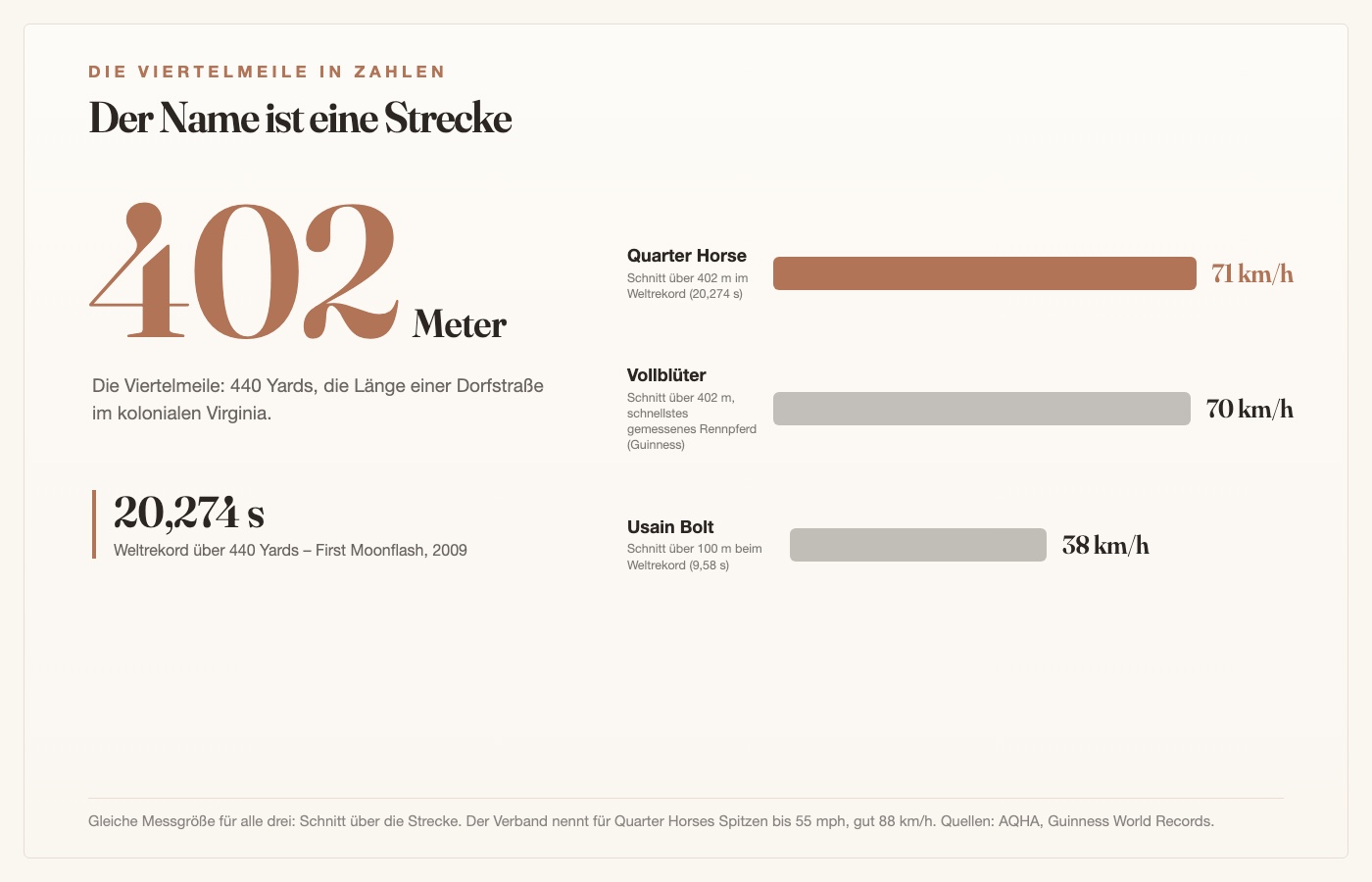
The trick is not top speed but how quickly it is reached. A Quarter Horse has to be at full speed within a few strides, or the race is over before it has begun. For that it needs exactly the hindquarters Janus brought with him: set low, wide, able to take the whole weight back and explode from there. Now think of a sliding stop, a rollback, a spin. Your reining horse brakes like a sprinter pulling up after 400 metres – it just leaves out the 400 metres. The breed changed its job. It kept its body.
The 95-dollar racehorse in your papers
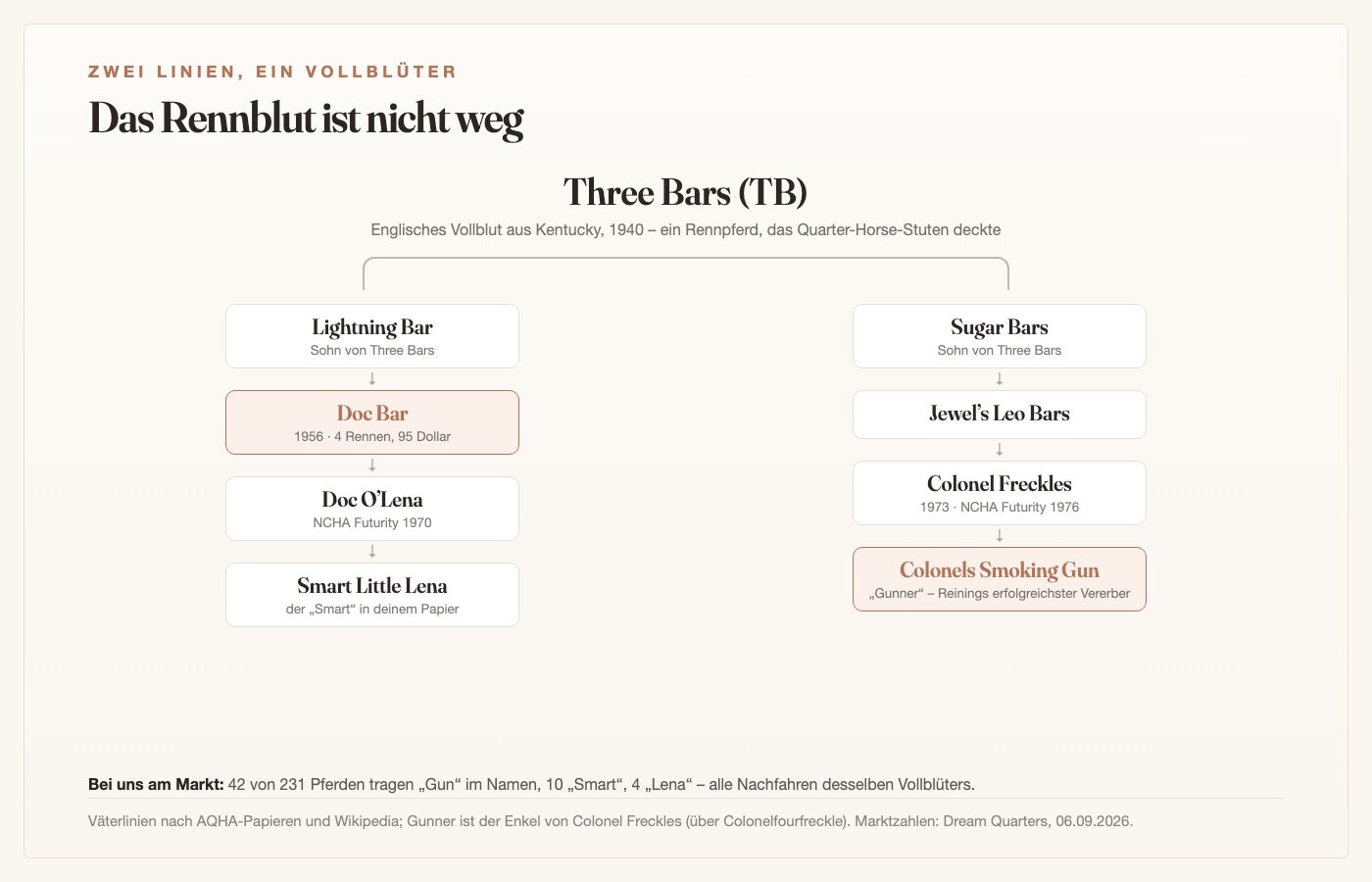
Which brings us to the horse that sealed the change. In 1956 a chestnut colt was foaled, bred like a racehorse: Doc Bar, son of Lightning Bar, grandson of the Thoroughbred Three Bars. He raced four times, finished third once, and earned 95 dollars in his entire racing career. As a racehorse he was a flop. In 1962/63 Dr. and Mrs. Jensen of the Double J Ranch in California bought him anyway, for 30,000 dollars – as a halter and breeding stallion. The rest is the history of the modern cutting and reining horse.
Doc Bar's sons and daughters won the big cutting futurities, and his grandson Smart Little Lena, a son of Doc O'Lena, became one of the most important sires there has ever been. Now read the names in your own papers: every "Smart", every "Lena", every "Chic" is, as a rule, a descendant of the 95-dollar horse. On our market, ten of 231 horses for sale carry "Smart" in their name and four carry "Lena" – and those are only the ones where it is written on the front.
The second great line leads to the same Thoroughbred. Three Bars, foaled in Kentucky in 1940, was an American-bred Thoroughbred who covered Quarter Horse mares in Arizona and California after his racing days – and who stands in the association's Hall of Fame today as one of the most influential stallions the breed has had. Through his son Sugar Bars and Sugar Bars' son Jewel's Leo Bars you reach Colonel Freckles, the 1976 NCHA Futurity champion, and from him, through his son Colonelfourfreckle, Colonels Smoking Gun: the stallion everybody just calls Gunner, to this day the most successful sire in the history of reining. 42 of our 231 horses carry "Gun" in their name. Both lines, Doc Bar and Gunner alike, run back to the same Thoroughbred. The racing blood is not gone. It just no longer stands on a racetrack.
Erftstadt, 1975: countable on one hand
The Quarter Horse came to Europe late and by roundabout ways. The Swiss Jean-Claude Dysli loaded the first two onto a ship in 1964 – that story is told in our guide to the legendary western trainers. When a few idealists met in Erftstadt on November 22, 1975 and founded the Deutsche Quarter Horse Association, the Quarter Horses in the country could, by their own account, still be counted on one hand. Today the association has more than 6,000 members, and by its own figures more than 40,000 Quarter Horses live in Germany – more than anywhere else outside the American continent.
You can feel that number on our site too: of 231 horses for sale on Dream Quarters, 202 are Quarter Horses, seven out of eight. None of them has ever run the quarter mile. Most of them stop as if they had just done so.
What this means for your horse
Three things to take from this story. First: the name is a distance, not a quota. Anyone telling you a Quarter Horse has "a quarter Thoroughbred" has confused the origin – even though there is real Thoroughbred blood in there. Second: the hindquarters a sprinter needs are the same ones a reiner needs. When you look at a young horse, look from behind first. Third: the names in the papers are not decoration. What Gun, Whiz and Dun It mean in detail is in our guide to reading reining bloodlines; which stallion stands behind a listing and which of his offspring are on the market right now is shown on our sire pages.
And if you have a certificate in front of you and are stuck – transfer of ownership, genetic tests – our papers page helps. All Quarter Horses currently for sale are in the search, the breeding stallions in the stallion directory. Every horse stands there as an equal and the order is random – a bit like two horses on a village street in 1674.