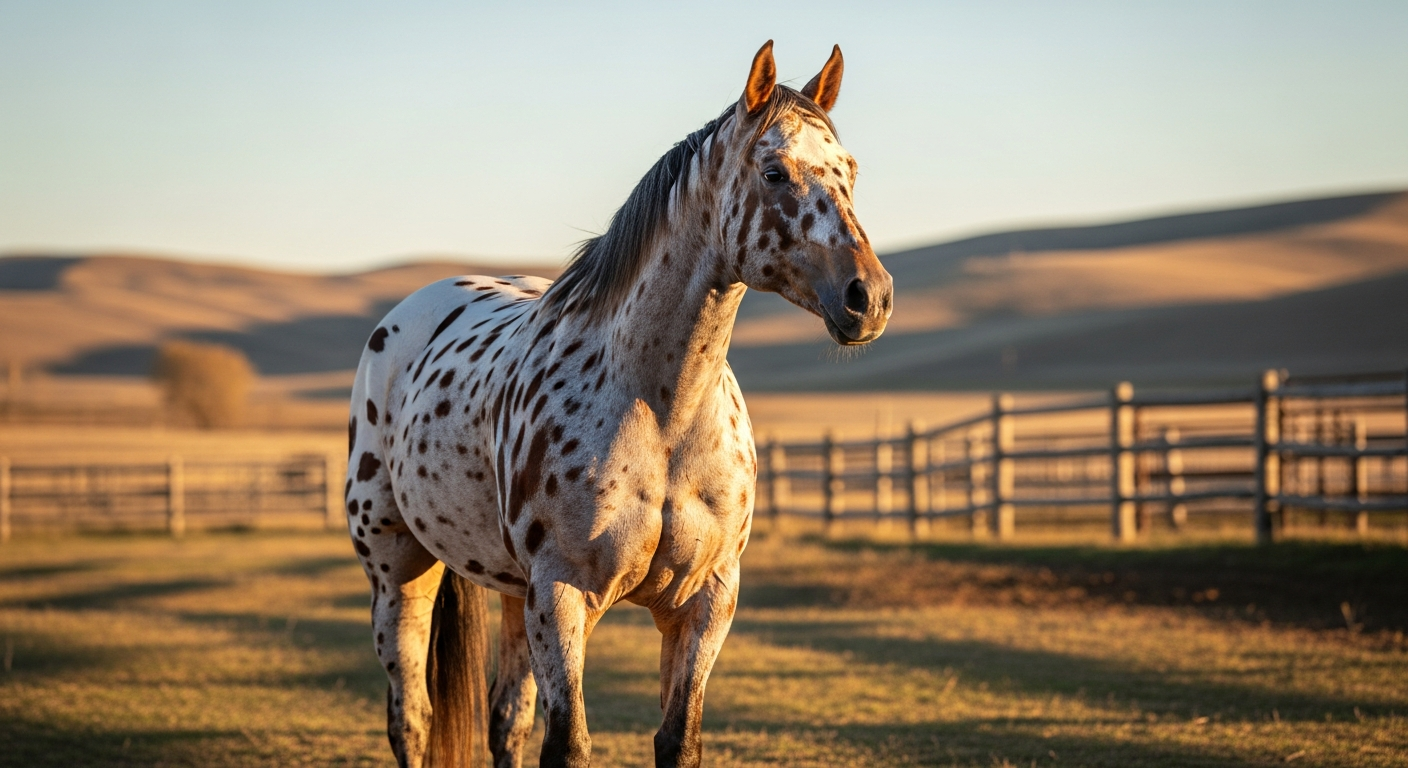
There are horses you can pick out from the other end of a field. A grey is a grey. A buckskin stands out. But an Appaloosa? An Appaloosa is visible from a considerable distance, in any light, under any weather conditions — spotted, speckled, roaned, with striped hooves and an expression that suggests it has formed considered opinions about its surroundings and most of the people in them. This is not a breed that goes unnoticed. Neither, it turns out, does its history.
Where Does the Appaloosa Come From? A Brief History Worth Knowing
The modern Appaloosa was developed primarily by the Nez Percé people of what is now the Pacific Northwest of the United States — among the first indigenous peoples of North America to practise selective breeding with genuine sophistication. They selected for coat pattern, conformation, and character simultaneously, producing a horse of remarkable endurance, versatility, and temperament. The result was extraordinary.
After the collapse of Nez Percé culture in the late 19th century, the breed nearly disappeared entirely. A small group of American enthusiasts preserved the surviving animals and founded the Appaloosa Horse Club (ApHC) in 1938 — today one of the largest breed registries in the world. The first Appaloosas arrived in Europe during the 1960s and 1970s, establishing communities in Germany and the Netherlands that continue to grow today. What the Nez Percé built, European breeders have carefully extended.
What Makes the Appaloosa Genuinely Different?
Buying an Appaloosa means getting considerably more than a coat pattern. This breed combines western durability with a character that makes it unmistakable both in the field and in partnership:
- Build: Compact, muscular, broad-hipped — classic Quarter Horse type that works equally well in a show pen, on a trail, or covering ranch ground
- Temperament: Balanced, intelligent, genuinely curious. Appaloosas think independently, which rewards good riders and exposes poor ones — a quality worth respecting rather than fighting
- Versatility: Trail, Ranch Riding, Reining, Western Pleasure, casual hacking — Appaloosas adapt and perform across disciplines with a reliability that consistently surprises people who encounter them for the first time
- Individuality: No two Appaloosas look alike. On a field of thirty horses, you will always find yours
Coat Patterns — The Appaloosa's Colourful Field Guide
At some point during the process of buying an Appaloosa, someone will ask about the pattern, and you will want a coherent answer. Here is the briefing:
- Leopard: White base with dark spots distributed across the entire body — the pattern most people picture when they think "Appaloosa." Dramatic and completely unmistakable.
- Blanket: Dark colouring on the front body, white blanket over the hindquarters — with or without spots within the blanket. Clean and striking.
- Snowflake: Dark base colour with white speckling, most concentrated on the hindquarters and back. Often develops and intensifies with age.
- Varnish Roan: Mixture of light and dark hairs with darker colouring over the bony prominences — a pattern that changes over the horse's lifetime in ways that remain quietly interesting.
- Few-Spot Leopard: Almost entirely white with only a few dark spots remaining — rare, spectacular, and genetic proof that the ApHC's founding breeders had excellent taste.
- Solid: Single base colour without obvious patterning — still registrable with the ApHC if breeding and breed characteristics are confirmed.
Beyond coat colour, the ApHC uses three physical markers to positively identify Appaloosas: mottled skin around the muzzle, eyes, and dock; visible white sclera around the iris (similar to the human eye); and striped hooves — alternating light and dark vertical stripes on the hoof wall. These three characteristics together identify a genuine Appaloosa more reliably than coat colour alone.
Appaloosa Prices in Europe — The Honest Numbers
Current realistic price ranges for the European market:
- Foal, unstarted: €2,500 – €6,000 (elite pedigrees and spectacular patterns command more)
- Young horse (2–4 years), started under saddle: €4,000 – €12,000
- Pleasure horse with solid training: €5,000 – €18,000
- Sport horse (Reining, All-Around, Trail): €15,000 – €45,000
- Proven show horse with competition record: €40,000 – €120,000+
An unusually low price on a healthy, trained Appaloosa — under €3,000 — merits careful investigation. Missing papers, unclear health history, and training gaps tend to be common in that range, and they tend to resurface later as veterinary bills. The breed-specific health considerations discussed below also factor into pricing; horses with tested genetics and clean eye history command appropriate premiums.
Bloodlines — What the Pedigree Actually Tells You
European Appaloosas typically carry strong Quarter Horse blood. The most relevant bloodlines determine type, temperament, and discipline fit:
Performance & Reining
- Rugged Lark — one of the most influential Appaloosa sires of the modern era: exceptional temperament, genuine versatility, and reliable production of balanced western types with cooperative character
- Bright Zip — NRHA performance blood, producing sharp, reactive Reining types with purpose and precision built into their stride
- Smart Chic Olena (Quarter Horse, frequently appearing in European Appaloosa pedigrees) — legendary softness and trainability that tends to make trainers genuinely emotional about their job
All-Around, Trail & Pleasure
- Jokers Jaguar — classic Appaloosa sire with exceptional patterning and calm character, well represented in European breeding
- Tiger — established European line with long tradition, particularly strong in Germany and the Netherlands, reliably producing good-tempered trail and pleasure types
- Poco Bueno derivatives — solid Quarter Horse foundation, dependable on the trail, genuinely easy to enjoy
A reputable breeder explains exactly what the bloodline means for temperament, discipline suitability, and foal production. If the answer is a shrug, that shrug is already a complete answer. Keep walking.
Health: CSNB and ERU — What Every Appaloosa Buyer Needs to Know
The Appaloosa carries two breed-associated health risks that every buyer should understand before signing anything. Neither is a reason to avoid the breed. Both are excellent reasons to approach the pre-purchase exam with specific intentions:
CSNB — Congenital Stationary Night Blindness
CSNB is an inherited, non-progressive retinal condition that occurs at disproportionate rates in Appaloosas with the Leopard coat pattern. Affected horses have poor or absent vision in dim light and darkness — during daylight, they may appear entirely normal. CSNB doesn't cause pain and doesn't progress, but it does meaningfully limit safe use: dark barns, unlit arenas, forest trails at dusk, and travel in low light can all be problematic.
- A genetic test for the LP gene and PATN1 modifier can assess the risk before purchase
- Homozygous Leopard patterning (LPLP) is strongly associated with CSNB — essentially all LPLP horses are affected to some degree
- An ERG (electroretinogram) can confirm retinal function during the pre-purchase exam; ask your vet about including it for Leopard-pattern horses
ERU — Equine Recurrent Uveitis
Appaloosas develop Equine Recurrent Uveitis (ERU) — a chronic, recurring inflammatory eye condition — at significantly higher rates than most other breeds. Left untreated or unmanaged, ERU can lead to blindness. It is treatable and manageable, but it requires ongoing veterinary involvement and cannot be cured.
- The visible white sclera characteristic of the breed increases UV exposure, which may be a contributing factor
- Ophthalmoscopic examination of both eyes should be part of any Appaloosa pre-purchase exam — not optional
- Ask for the eye history of the horse and its parents. A reputable seller has this information immediately available.
Both conditions are manageable when identified and planned for. Knowing is always better than finding out later. The pre-purchase exam is where you find out.
Pre-Purchase Exam — More Thorough Than You'd Run for Other Breeds
A veterinary pre-purchase examination is non-negotiable for any horse purchase. For an Appaloosa, run an expanded version:
- Level I: Clinical examination — general condition, teeth, heart, lungs, limbs
- Level II: X-rays of limbs and spine
- Level III: Ultrasound (tendons, ligaments) and airway endoscopy
- Eye examination: Full ophthalmoscopic examination for ERU signs — strongly recommended, not a nice-to-have
- Genetic test: LP gene panel for CSNB risk — particularly important for Leopard-pattern horses
The vet must be independent — not the seller's regular vet. Reputable sellers support the examination fully and provide all available previous records without being asked twice. Hesitation at this point is already a data point.
ApHC Registration in Europe
The official registry is the Appaloosa Horse Club (ApHC), based in the United States. European points of contact:
- Germany: Freie Appaloosa-Hengst-Register (FAHR) and direct ApHC membership
- Austria and Switzerland: Direct ApHC membership or through German partner organisations
- Italy: Associazione Italiana Appaloosa (AIA) — national affiliate with ApHC connection
- Netherlands: Dutch Appaloosa Horse Association (DAHA) — one of the most active Appaloosa communities in Europe
At purchase, you receive the ApHC Certificate of Registration. Name, microchip number, coat pattern, and breed characteristics (sclera, hoof stripes, mottled skin) should correspond with the horse in front of you. Ownership transfer runs through the ApHC — allow a little more time than for European-only registrations.
Disciplines — What the Appaloosa Does Best
- Trail and long-distance riding: Perhaps the most natural fit — Appaloosas are sure-footed, genuinely enduring, and handle unfamiliar environments calmly. On the trail, this breed particularly shines.
- Ranch Riding: Reliability, ground-covering movement, and real-world usability — exactly what ranch work rewards
- Western Pleasure and Horsemanship: Good movement, cooperative temperament, and the kind of presence that photographs well at a show
- Reining: With the right bloodlines, fully competitive. Rugged Lark and Performance Quarter Horse lines produce genuine Reining prospects
- Breeding: European Appaloosa breeding is active and growing — dramatic coat patterns and solid character genetics generate consistent demand for quality foals
- Family and leisure riding: The Appaloosa's balanced character and manageable size make many individuals excellent choices for families, junior riders, and returning adults
Common Mistakes When Buying an Appaloosa
- Skipping the eye examination: The single most important Appaloosa-specific addition to the pre-purchase exam. Not negotiable.
- Buying based on photos or videos: A spectacular coat pattern is distracting in the best possible way — which makes it a useful tool for overlooking other things. Always visit in person.
- Skipping the AKU entirely: "He looks healthy" is not a veterinary assessment. It never is.
- Allowing time pressure: "There's another interested buyer coming tomorrow morning" is a very old sentence. Reputable sellers don't pressure. Take two visits.
- Buying without papers: Without ApHC registration, you're buying a horse without verifiable breeding history. For breeding purposes this is simply not an option. For resale, a meaningful reduction in value.
- Wrong discipline match: A highly trained show horse isn't an easy trail companion. Ask exactly how the horse is used daily — and picture yourself in that situation honestly.
- Underestimating follow-on costs: Transport, settling-in period, new equipment, initial vet visits — budget a minimum of 10–15 % above the purchase price as a reserve.
Buying an Appaloosa in Europe — Where to Look
Buy exclusively through transparent, verifiable sources. On Dream Quarters you'll find Appaloosas from verified breeders and private sellers across Europe — with clear information on bloodline, training level, coat pattern, and direct contact with the seller.
Appaloosas on Dream Quarters
- Horses from breeders and private sellers across Germany, Austria, Switzerland, Italy, and all of Europe
- Clear listings with bloodline, price, training level, and coat pattern information
- Breeder profiles with stable information and foal announcements
- Appaloosa stallions with ApHC bloodlines and documented health testing
Further reading: Buying a Quarter Horse in Europe · Buying a Paint Horse in Europe
Read next: Considering an Appaloosa foal instead of a finished horse? Our foal-buying guide covers selection, pedigree, vet check and realistic costs.
Read next: Before you bring your Appaloosa home, take ten minutes for our horse purchase agreement guide — it shows which clauses protect buyer and seller and where the most common pitfalls hide.
Read next: Before you commit, do the honest math. Our guide how much does a Western horse cost? walks through realistic ranges for purchase, board, farrier, vet and insurance across DACH and Italy — May 2026.
Conclusion — The Appaloosa is a Decision That Stays With You
Buying an Appaloosa means choosing a horse that stands out — in the field, in the arena, on the trail. But the appearance is only the introduction. What follows is a horse with a history that spans centuries, a character that combines genuine independence with real willingness to work, and a coat that no other horse in any barn will ever quite replicate.
Take your time. Have the eyes examined. Request the papers. Get independent professional assessment. Never skip the pre-purchase exam — and when it's an Appaloosa, add the ophthalmoscopic check without hesitation. And then enjoy every ride, including the ones where the horse has a perfectly clear opinion about something that you did not anticipate. Those make the best stories.
"The best horse isn't the most expensive — it's the one that fits you." — Dream Quarters Team