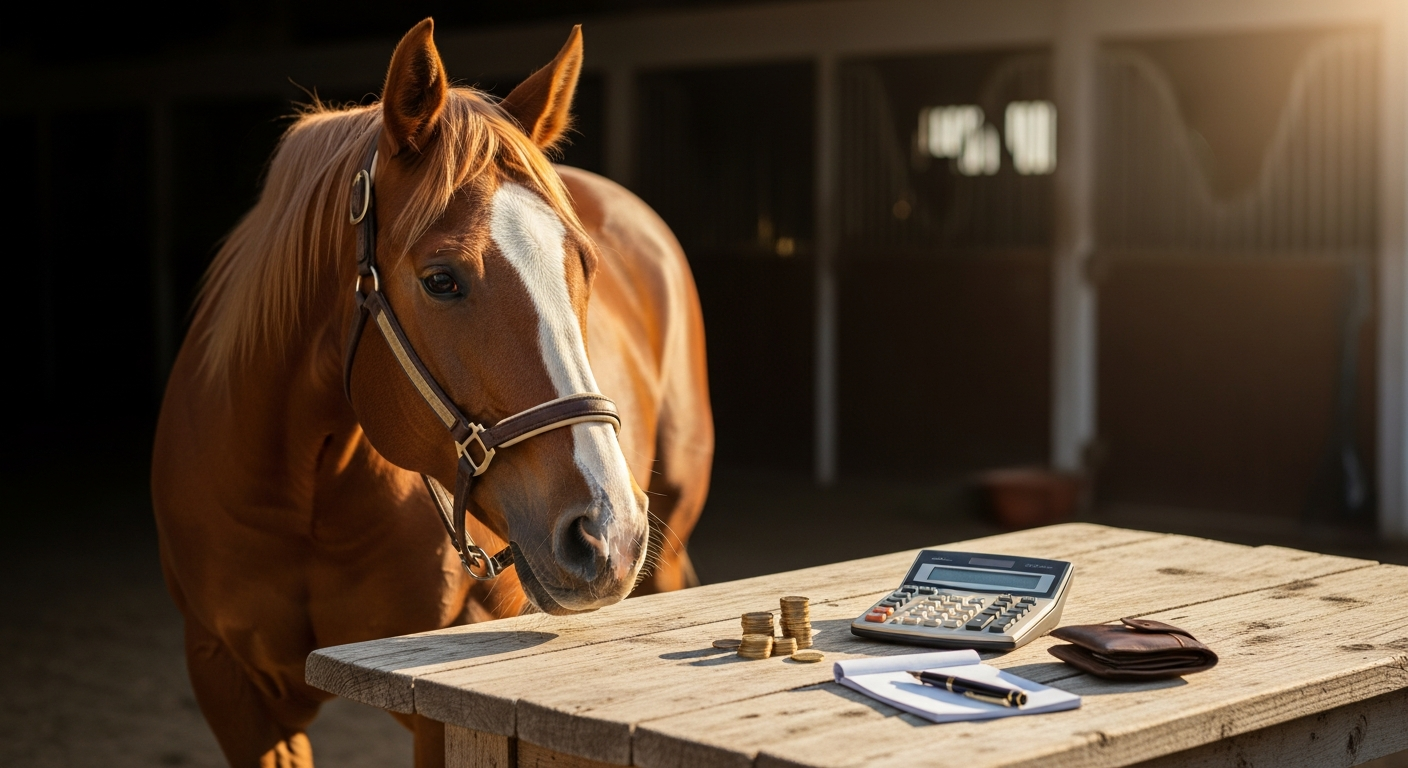
How much does a Western horse really cost? Not just at purchase, but month after month, year after year. This guide walks through every line item transparently: from purchase price to board, farrier, vet, insurance and the costs almost every first-time buyer underestimates. With realistic ranges for Germany, Austria, Switzerland and Italy - so you know what you are signing up for before you sign.
As of May 2026, indicative only. All figures are market observations, not advice. Real costs vary widely by region, stable, horse and lifestyle. This article is general guidance and does not replace individual financial or veterinary advice.
1. Purchase price: what does a Western horse cost up front?
Purchase price is driven by training, pedigree, age, health and show record. A rough orientation for the European market in May 2026:
- Entry / leisure horse (rideable, healthy, no show record): about EUR 3,500 - 7,000. Often older horses or with small limitations, but with character and experience. For many returning riders and family riders, the most honest choice.
- All-around / amateur show horse: about EUR 7,000 - 15,000. Solid training, clear pedigree, often Quarter Horse, Paint or Appaloosa - see our breed guides on Quarter Horse, Paint Horse and Appaloosa.
- Show / open amateur: about EUR 15,000 - 35,000. Show experience, trainer support, often Pleasure, Trail or All-around.
- Pro show / specialist discipline (e.g. reining): about EUR 30,000 - 80,000, with top horses well above.
- Breeding / top stallion / embryo from elite line: from EUR 50,000 into six figures. See also buying a breeding stallion.
- Foal: typically EUR 2,500 - 12,000, top foals from established performance lines significantly more - details in the foal-buying guide.
For a wider orientation by discipline and breed, our hub article buying a Western horse is the place to start.
2. One-time costs at purchase
Beyond the price tag, several one-time items easily get lost in the excitement:
- Pre-purchase exam (PPE): small clinical about EUR 250 - 500, large with X-rays EUR 800 - 2,000, depending on number of views and region. Recommendations in the PPE guide.
- Transport: within DACH typically EUR 1.20 - 2.00 per kilometre commercial. From Italy, France or Scandinavia plan EUR 800 - 2,500 per horse. EU-compliant logistics in horse transport in Europe.
- Contract paperwork and documents: equine passport transfer, owner change in the breed registry (typically EUR 30 - 150). Cross-border purchases may require veterinary certificates and translations. More in the horse purchase agreement guide.
- VAT and customs: usually irrelevant in EU private sales, relevant when buying from a dealer. Third-country movements (e.g. Switzerland to/from EU) trigger import duties - budget conservatively.
Rule of thumb: plan 10 to 20 percent of the purchase price on top for one-time costs - but at least EUR 2,000.
3. Monthly board across DACH and Italy
Boarding is the single biggest monthly lever. Indicative ranges for May 2026, regional variation is significant:
- Full board, individual stall: in DE typically EUR 400 - 700, in metro areas and CH up to CHF 900 - 1,300, in AT EUR 350 - 650, in IT EUR 300 - 550 (north pricier than south).
- Open / active barn (group housing): usually EUR 250 - 500, sometimes cheaper. Often more horse-appropriate, with movement and social benefits.
- Self-care board: pasture/stall EUR 80 - 250, plus hay, bedding, electricity, water and above all your time (two hours a day, every day).
- Summer pasture package: in many regions EUR 100 - 250 for grazing in summer, with full or open board the rest of the year.
Always ask exactly what is included: hay, mineral feed, bedding, manure removal, indoor arena access, pasture. Hidden surcharges (haynet, special mineral feed, indoor arena fee) easily push the honest monthly bill EUR 50 - 150 higher.
4. Feed, bedding and supplements
Usually included in full board - in self-care or own-feed setups the line item is visible:
- Hay: a 500-kg Western horse eats around 9 - 12 kg per day. Good hay costs EUR 15 - 30 per 100 kg depending on region - that is EUR 40 - 110 per month.
- Concentrate / muesli: leisure use EUR 20 - 60, sport horses more.
- Mineral feed: EUR 10 - 25.
- Bedding (shavings, straw, pellets) self-care: EUR 30 - 80.
- Seasonal supplements (gut support, hoof, electrolytes): EUR 0 - 40.
Realistic on top of what board includes: EUR 60 - 200 per month for feed and bedding extras.
5. Farrier and hoof care
Every 6 to 8 weeks the farrier visits. Per-visit ranges in DACH, May 2026:
- Barefoot trim: EUR 50 - 90.
- Four shoes: EUR 120 - 200.
- Specialty / orthopedic shoeing: EUR 180 - 350.
Annualised: barefoot EUR 400 - 700, shod EUR 900 - 1,500, specialty significantly more. Travel surcharges add up in rural areas.
6. Vet - routine and emergency
Routine costs are predictable, emergencies are not:
- Vaccinations (influenza, tetanus, herpes if applicable): EUR 120 - 220 per year.
- Deworming or selective deworming with fecal egg count: EUR 40 - 120 per year.
- Dental check / floating: EUR 120 - 250 per year.
- Total vet routine budget: EUR 350 - 600 per year.
- Emergencies: colic with conservative treatment EUR 500 - 2,000, colic surgery in clinic EUR 5,000 - 10,000, severe lameness with MRI/diagnostics EUR 1,000 - 3,500. This is exactly where insurance pays off.
7. Insurance, training, shows and other variable costs
Three insurance categories are common for horse owners in continental Europe - each covers a different risk. The ranges below are rough orientation only; every policy has its own terms, deductibles and exclusions you must check individually.
- Owner liability insurance - covers damage your horse causes to third parties. In DE often EUR 60 - 150 per year, similar in CH and AT. Practically essential; in some regions even mandatory.
- Surgery insurance - covers clinic costs for surgery (e.g. colic). EUR 200 - 500 per year, depending on deductible, horse age and provider.
- Mortality / life insurance - kicks in on death or required euthanasia, especially worthwhile for valuable horses. Rule of thumb: about 3 to 6 percent of insured value per year.
Which policy is right for you depends on horse value, discipline, risk tolerance and reserves - get an independent comparison from a horse-specialist broker before signing.
Other variable items depending on lifestyle:
- Lessons / trainer: typically EUR 40 - 80 per hour. Still looking for the right one? See the trainer-finding guide.
- Weekend clinics and courses: EUR 150 - 450 per session.
- Show entries, trailer, fuel, registrations: realistic amateur show season EUR 500 - 2,000.
- Tax angle: in DE and AT mostly irrelevant for private horses; in Switzerland and parts of Italy regional variation applies. Consult a local tax professional for any non-trivial setup.
- Budget for tack separately - a Western saddle and bridle are a substantial line item that a local saddler or trainer can scope honestly for your specific horse.
Still deciding whether Western riding is your discipline? Start with our hub learning Western riding.
8. Annual totals and an honest worked example
Three realistic annual scenarios for 2026, excluding purchase price, saddle and shows:
- Frugal self-care / open barn, barefoot, basic care: about EUR 4,000 - 5,500 per year.
- Full board mid-tier DE, shod, routine plus insurance, occasional trainer: about EUR 7,500 - 10,500 per year.
- Full board CH or metro area, show horse, regular trainer, small show season: about EUR 12,000 - 18,000 per year - and open-ended upward.
Across a typical 25-year Western horse life, mid-tier running costs add up to EUR 180,000 - 250,000. The purchase price is usually only the entry ticket.
Frequently asked questions about Western horse costs
What is the realistic minimum monthly budget?
In Europe, plan a minimum of EUR 350 - 500 per month in baseline costs - even with frugal open-barn boarding, barefoot, no trainer and no big vet bills. Realistically, depending on region and lifestyle, EUR 600 - 900 is closer to typical. Anyone planning under EUR 300 long-term risks financial strain at the first emergency.
Which cost line do buyers underestimate most?
Unexpected vet bills. A single colic surgery can run into five figures, severe lameness with MRI several thousand euros. If you cannot hold a reserve of EUR 5,000 - 10,000 and have no surgery insurance, seriously evaluate one. Farrier costs are also routinely underestimated - shod horses easily reach EUR 1,000 - 1,500 per year.
How do costs differ between Germany, Austria, Switzerland and Italy?
Switzerland is roughly 40 to 80 percent more expensive than DE/AT for board, farrier and vet, though incomes are correspondingly higher. Italy is often cheaper than DE in the south for board and similar in the north. Austria is broadly at DE level. Insurance structures are similar across countries; exact premiums vary. For CH, conservatively add about 30 percent to all ranges in this article.
Is leasing a horse worth it instead of buying?
A part-loan typically costs EUR 100 - 300 per month and is ideal to test whether full ownership really fits. Full lease of a show horse often runs EUR 300 - 800 per month plus a share of vet costs. Leasing reduces financial risk from illness and depreciation and is often the more honest choice for working professionals in uncertain life phases compared with outright purchase.
What does a Western horse cost in total over its lifetime?
Across a 20 - 30 year lifespan with mid-tier care in continental Europe, running costs realistically total EUR 150,000 - 280,000. The purchase price itself is usually under 10 percent of total cost of ownership. Buying a horse is mostly buying a long commitment of care and responsibility - that is the most honest answer to the cost question.
Disclaimer: All figures in this article are May 2026 market observations and indicative only. They do not replace individual financial, tax or veterinary advice. Get local quotes before any major commitment and talk to your barn operator, farrier, vet and insurance advisor.
Conclusion: realistic numbers, relaxed purchase
Buyers who do the math honestly enjoy their horse longer and do not give up frustrated after three years. Three levers matter:
- Purchase price is only the entry ticket - plan a minimum of EUR 5,000 per year in running costs.
- Insurance over hope - owner liability is essential, surgery insurance is strongly advisable.
- Hold a reserve - EUR 5,000 - 10,000 in liquidity for emergencies. Owners who have it live noticeably calmer with their horse.
A Western horse is one of the most rewarding hobbies - but not a cheap one. Honest math means longer joy. And if you do end up selling: our selling guide walks you through it.
"The cheapest horse is the one you can still afford three years from now." - Dream Quarters Team