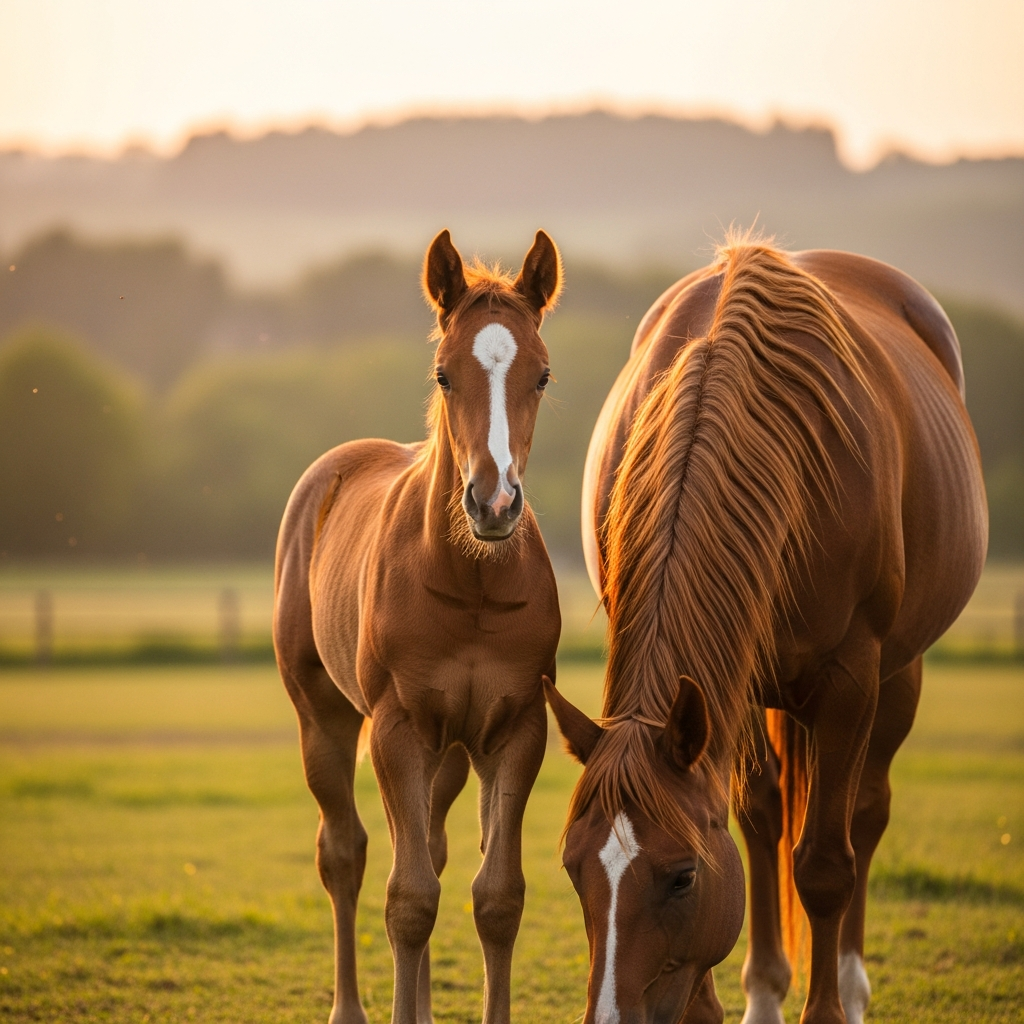
Buying a foal is a different game from buying a finished riding horse. You're not just acquiring an animal - you're acquiring a promise: three to four years of raising, training and patience before the horse is truly ridable. This guide walks you through what really matters when you buy a foal: selection, pedigree, health, prices, contract, and the first transport home.
As of May 2026. Price figures are market estimates and non-binding. Veterinary and registry rules can change - always check current requirements with your association before buying.
1. Why buy a foal - and why maybe not?
Before you start the search, be honest with yourself: a foal isn't right for everyone. There are good reasons for it - and equally good reasons against.
- Pro: You shape the horse from day one - trust, ground manners, handling. You pick the bloodlines deliberately for your future goal (reining, ranch work, trail, all-around). The entry price is lower than for a finished horse from comparable lines.
- Con: You need patience - three to four years before you can really ride. You need raising facilities or a good raising barn (more in section 7). You need experience or a good trainer behind you, because mistakes in the early years are hard to fix later.
- Golden rule: Anyone who has never raised a horse should not raise their first foal alone. An experienced trainer or horseman in the background is mandatory.
If you're unsure whether a foal fits your situation, a well-trained four-to-seven-year-old is often the smarter choice. See also our Western horse buying guide.
2. Which foal fits you? Breed, sex, discipline
In Western riding there is no single "right" foal. Your choice starts with three questions: which discipline do you want to ride later? Which breed fits your style? Filly, gelding (later) or colt?
Breed and bloodlines
- Quarter Horse - the all-rounder: strong in reining, cutting, ranch work, trail. Calm temperament, versatile. The most popular Western breed in Europe. More in our Quarter Horse buying guide.
- Paint Horse - related to Quarter Horse genetics, plus the distinctive coat pattern. Same disciplines, more visibility in the show pen. Details in the Paint Horse buying guide.
- Appaloosa - independent, full of character, with the iconic spotted coat. Tough, often gifted on the trail and in ranch work. More in the Appaloosa buying guide.
Discipline as a selection criterion
If you have a clear sport goal, pick the bloodlines deliberately. A foal from a pure reining program brings different qualities than an all-around Quarter Horse from a ranch line. Plan your destination before you buy your horse. For reining-minded buyers, our reining horse guide is a good starting point.
Sex: filly, gelding, or colt?
- Gelding (future): The most straightforward choice. Colts are usually gelded between one and three years old (your decision, in consultation with vet and trainer). Geldings are reliable sport and leisure horses.
- Filly: A bit more independent, sometimes hormonally variable. Plus: you keep the breeding option open later.
- Stallion: Only for very experienced owners with proper stallion facilities and serious breeding intent. Not a "bonus ticket."
3. Pedigree and papers - the most important invisible asset
When you buy a foal, you are largely buying genetics and expectations. What the foal can do today says little - who its parents and grandparents are says a lot. These are the points to clarify:
- Registration with the breed association (AQHA, APHA, ApHC, or European equivalent). Papers are usually issued during the first year of life - ask the seller whether registration is in progress or already complete.
- Pedigree certificate with at least three generations. Look for repetition of outstanding lines (line breeding) and known show or performance ancestors.
- Sire (stud): Is the stallion registered, does he have show or breeding accomplishments, are half-siblings known? For evaluating or selecting a stallion, see our detailed stud stallion guide.
- Dam (mare): Often underestimated - the dam shapes character, movement and health at least as much as the sire. Ask: does she have show experience? How did her previous foals turn out? What is her temperament like?
- Genetic tests - in Quarter Horse, Paint and Appaloosa programs, serious breeders test for the "five diseases" (HYPP, GBED, HERDA, MH, PSSM1). Ask for the parents' test results - if both are negative, the foal cannot develop the disease (at least for HYPP/GBED/HERDA/MH).
- EU equine passport - mandatory at sale, issued in the first 12 months of life. No passport, no transport, no boarding, no insurance.
4. Evaluating the foal in person - what really counts?
Compared to an adult horse, there's a lot you can't yet check on a foal. Still, there are clear points to watch:
- General condition - bright eyes, shiny coat (factor in seasonal shedding), no cough, no nasal discharge, normal manure.
- Movement at walk and trot in the paddock - even, in rhythm, no lameness. A foal should look playful and curious.
- Conformation and limbs - no extreme cow-hocks or sickle-hocks, no obvious carpal valgus or knock-knees. Mild deviations may correct as the foal grows - if uncertain, bring an equine orthopedic specialist.
- Hooves - regularly trimmed, balanced, not neglected. A farrier can spot stance tendencies even at this age.
- Behavior toward dam and humans - alert, curious, accepts handling. A shy foal may simply lack early imprinting, not necessarily character problems.
- Social behavior - plays with other foals, neither aggressive nor apathetic.
What you cannot judge yet: the future riding horse quality. Anyone who guarantees a foal will "definitely" become a top horse is overselling. Serious breeders describe line strengths and observations on the foal without giving guarantees.
5. Pre-purchase exam on a foal
A pre-purchase exam (PPE) makes sense on a foal too - but it looks different than for an adult riding horse. What matters:
- Clinical exam - heart, lungs, eyes, navel, testicle check on colts, movement at walk and trot. Standard and strongly recommended.
- X-rays - more limited usefulness on foals because many structures are still growing. Useful: limb conformation, growth plates, OCD predisposition (especially in sport lines). Discuss openly with the vet.
- Genetic tests - if the parents weren't tested and the lines are sport- or all-around, this can be a useful add-on.
- Use your independent vet - not the seller's farm vet. Cost typically €250-700 depending on scope, more with extensive X-rays.
For more on the exam itself, interpreting findings, and contract clauses, see our buyer's guide to the pre-purchase exam.
6. Prices and ongoing costs - the honest math
What does a foal cost? Spreads are wide because pedigree, sex, region and season vary heavily. These ranges help you size up the market (as of May 2026, non-binding, German and Western European market):
- Quarter Horse / Paint / Appaloosa all-around foal from hobby breeding: approx. €2,500-5,000.
- Quarter Horse / Paint / Appaloosa from solid show breeding: approx. €5,000-12,000.
- Foals from top lines (reining, cutting, established show sires): €12,000-30,000+, in individual cases significantly more.
- Embryo-transfer foals or imported US genetics: add a premium depending on pedigree and embryo marketing.
What comes after the purchase
The purchase price is just the beginning. Plan realistically for raising the foal until starting under saddle at four:
- Raising costs (boarding, pasture, hay, mineral feed): about €250-450 per month at a solid European raising facility. Over three years that's €10,000-15,000.
- Farrier: every 6-10 weeks, at first just trims, later shoes - about €40-100 per appointment.
- Vet: routine vaccinations, deworming, dental check - about €200-400 per year.
- Insurance: equine third-party liability mandatory from handover (€10-30 per year).
- Starting under saddle and basic training from year three or four: 3-6 months of professional starting, depending on region €700-1,400 per month.
Reality check: A €4,000 foal will quickly cost you €15,000-25,000 by the time it's a started four-year-old - including raising and starting. Plan for that from day one.
7. Weaning, transport and settling in
Foals in Europe are typically weaned around six months of age. Sale should ideally be agreed before that, but transport should not happen on the same day as weaning - that would be double stress. Recommended sequence:
- Weaning at the breeder's - after weaning, the foal should ideally spend two to four weeks in its familiar herd before transport.
- Transport - preferably with a professional shipper if the route is over 200-300 km. Young horses are more transport-sensitive than adults. Ideal: a calm second horse as a companion in the trailer. All paperwork, costs and EU rules are covered in our horse transport guide.
- Find a raising facility - most private owners don't have their own foal herd. A good raising barn offers year-round pasture, social contact with peers, regular hoof care and an experienced caretaker. Ask for references.
- Settling in - allow two to four weeks for the foal to integrate into the new herd. First days: quiet observation, no pressure.
8. Contract and risk protection
A written purchase contract belongs to a foal sale too. These points should be in it:
- Identification: name, date of birth, microchip number (if assigned), pedigree, sire and dam.
- Purchase price and payment terms - common: deposit on signing, balance at handover.
- Handover date - often "after weaning, no earlier than [date]." Who pays raising and vet costs until then?
- Risk transfer - when does risk (death, illness, injury) pass to you? Common practice: at loading at the breeder's farm. From that moment, you need insurance.
- Quality agreement - what is warranted? "Sold as inspected" is common but doesn't excuse hidden defects the seller knew or should have known.
- PPE clause - agree that the sale only goes through if the PPE shows no significant findings. Protects both sides.
- Papers - original equine passport handed over at transfer. Registration papers follow if not yet issued - record the deadline and responsibility in writing.
Frequently asked questions about buying a foal
At what age can a foal be sold?
Contractually, a foal can be sold at any time. Handover and transport, however, should only happen after weaning - typically around six months old. Earlier separation from the dam is problematic from an animal welfare perspective and not common practice.
What does a Quarter Horse foal cost in Europe?
As of May 2026, all-around foals from hobby breeders typically run €2,500-5,000, show-bred foals €5,000-12,000, top foals from established performance lines €12,000-30,000 and up. Spreads are wide and market-dependent - figures are non-binding.
Do I need a pre-purchase exam on a foal?
Yes, it makes sense in almost all cases. A clinical exam is standard. X-rays are less informative on a foal than on an adult, but can still be useful in sport-bred lines. Important: an independent vet, not the seller's.
How much does it cost to raise a foal to a riding horse?
Realistically expect €250-450 in monthly raising costs, plus farrier, vet, insurance. Over three to four years, raising and routine costs alone easily total €12,000-20,000, plus starting under saddle and basic training.
What do I check on the dam before buying?
The dam shapes character, movement and health significantly. Look at general condition, behavior, show or riding accomplishments, previous foals, genetic tests and conformation. If the breeder won't or can't show you the dam - be cautious.
Read next: Foal contracts have a few specifics — handover after weaning, raising-cost allocation, paper transfer. Our horse purchase agreement guide explains which clauses matter especially for foals.
Read next: Before you commit, do the honest math. Our guide how much does a Western horse cost? walks through realistic ranges for purchase, board, farrier, vet and insurance across DACH and Italy — May 2026.
Bottom line: a foal is a long-term promise
Whoever buys a foal is buying time, patience and a piece of the future. Three things matter most:
- Evaluate pedigree honestly - sire and dam, lines, genetic tests, papers.
- Inspect carefully on site - dam present, movement, conformation, PPE with an independent vet.
- Plan costs realistically - the purchase price is one third. Raising, vet, farrier and starting come on top.
Get those three right, and be willing to invest three or four years of patience, and a foal you raised yourself can become the most reliable horse of your life. Good luck on the way!
"A foal isn't a horse you buy - it's a horse you make." - old breeder saying