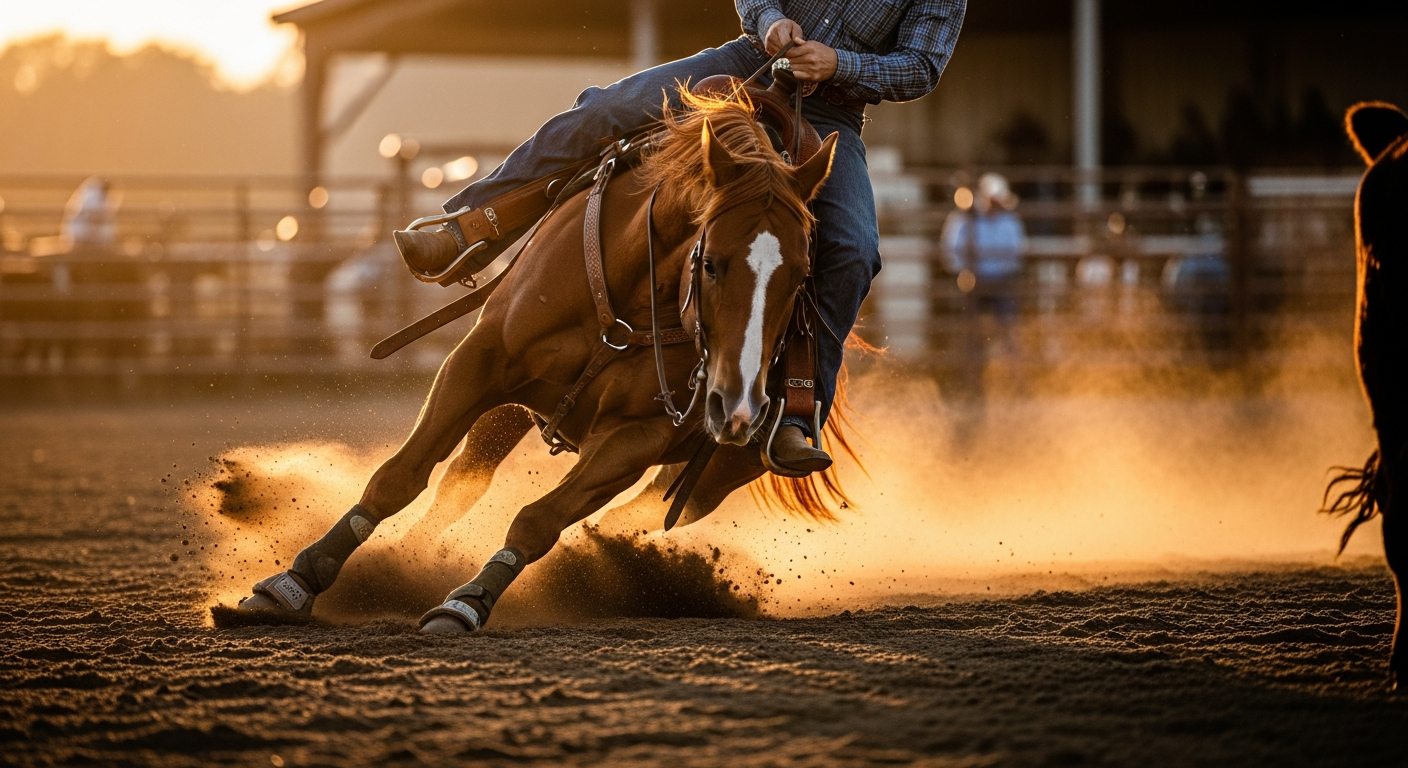
The moment a cutting horse drops its head, locks onto a cow, and the rider lays the reins on its neck — that is the moment the sport begins. No commands. No steering. The horse reads, anticipates, and mirrors the cow on pure instinct. Cutting is western horsemanship at its most elemental, and Europe has built a genuine cutting community over the past two decades.
Updated: May 2026. All prices are indicative for the European market and may vary by training level, bloodline, and availability.
What Is Cutting?
Cutting traces directly to 19th-century ranch work on the American Great Plains, where cowboys and horses had to separate individual cattle from a herd for branding, treatment, or sale. What began as practical necessity became a formalized competitive sport, and the National Cutting Horse Association (NCHA) — founded in 1946 — is today the world's largest western horse organization, awarding over $40 million in prize money annually.
In competition, a horse and rider have 2.5 minutes to select a cow from a herd, drive it away from the group, and then control it. Once the horse commits to a cow, the rider must drop the reins onto the horse's neck — and cannot pick them up again for that run. If they do (called "quitting the cow"), the run is penalized. From that moment on, the horse works entirely alone: blocking the cow's escape, mirroring every move, and keeping it separated from the herd.
Five judges score runs from 60 to 80 points. A score of 70 represents an average run. Scores above 75 are exceptional. The world record, set at the NCHA Futurity, is 225 (three judges giving 75s). Judges reward: difficulty of the cow selected, herd control, athleticism, and how convincingly the horse dominates the cow.
Cutting in Europe: The Current Landscape
NCHA Europe coordinates the sport across the continent. The strongest markets are Germany, Switzerland, Austria, the Netherlands, Spain, and Italy, with France and Scandinavia growing fast. Key annual events:
- NCHA Europe Futurity & Derby — the continent's most prestigious cutting event, rotating between countries
- German Cutting Championship — organized through the Deutschen Quarter Horse Verband (DQHV)
- Swiss Cutting Open — draws an international field including top US trainers
- Italian Cutting Championship — a rapidly growing scene, particularly strong in Veneto and Emilia-Romagna
European cutting has matured significantly. American trainers now regularly run European operations, frozen semen from the world's elite stallions is accessible, and European-bred cutting horses increasingly compete at US Futurities and Derbies.
What Makes a Cutting Horse?
Two qualities separate a cutting horse from everything else — and neither can be fully trained into a horse that lacks them: cow sense and the right physical architecture.
Cow sense is the instinctive drive to read, track, and control cattle. A horse either has it or it doesn't. You can teach a horse the mechanics of a cutting run, but a horse without natural cow sense will never fully take over when the reins go down. Experienced trainers can identify it in young horses the first time they're exposed to cattle — and they can tell within minutes whether a prospect is worth developing.
Conformation
- Short, powerful hindquarters with a low-set croup — enables the deep, rapid "drops" and hip-swinging stops
- Wide, muscular stifle and gaskin — the engine for explosive lateral movement
- Naturally low head carriage — the horse must read the cow from below, not above it
- Short back, wide chest — stability and quickness through turns
- Well-angled shoulder — absorption and reach in lateral steps
- Excellent bone and feet — cutting puts enormous stress on joints; sound structure is non-negotiable
Temperament
The ideal cutting horse is alert, reactive, and mentally resilient. Too nervous and the horse loses focus under the pressure of a tournament environment. Too dull and it can't match the speed of an agile, evasive cow. The sweet spot is focused intensity — a horse that locks in, stays locked in, and doesn't rattle when things go sideways.
Top Bloodlines: What You Need to Know
No western discipline is more bloodline-dependent than cutting. The following stallions define the modern gene pool and appear in the pedigrees of virtually every competitive cutter today:
- Metallic Cat (High Brow Cat × Chers Shadow) — the single most influential living cutting stallion in the world. His offspring have earned over $35 million in combined NCHA earnings. Frozen semen is widely used in Europe. Expect to see "Metallic" in top pedigrees for another generation.
- High Brow Cat (Tom Cat × Smart Little Kitty) — Metallic Cat's sire, and the foundation of the modern cutting pedigree. Deceased 2014; frozen semen still available and highly sought after.
- Peptoboonsmal (Peppy San Badger × Lenaette) — a legendary sire with generational influence. His offspring are known for exceptional cow sense and a particular athleticism that is immediately recognizable in the pen.
- Smart Chic Olena (Smart Little Lena × Gay Sugar Chic) — a versatile producer strong in both cutting and cow horse. Known for excellent structure and trainability.
- Dual Rey (Dual Pep × Nurses Rey) — powerful producer in NCHA and NRCHA, respected for bone, disposition, and natural cow.
- One Time Pepto (Peptoboonsmal × Miss Dual Pep) — one of the most impactful sires of the last decade, known for athleticism and ease of training.
- Smooth As A Cat (High Brow Cat × Shes Pretty Smooth) — a son of High Brow Cat with outstanding offspring, particularly in European competitions.
Explore: Browse breeding stallions listed on Dream Quarters — including stallions with cutting bloodlines standing in Europe.
Training Levels and What They Mean
Cutting horses are described by training stage, and understanding this hierarchy is essential for setting a budget and finding the right match:
- Unstarted (2-year-old) — no cattle work; basic groundwork only. The cheapest entry point, but also the highest risk: you don't yet know if the horse has cow sense. From €3,000.
- Green on Cattle — first exposure to cattle, shows instinct but not yet formed. For experienced trainers who want to develop a prospect themselves. €5,000–€15,000.
- Amateur-Ready — runs cleanly at entry-level shows, knows its job. Best entry point for newcomers with access to a coach. €15,000–€40,000.
- Finished Cutter / Open Level — competition-proven at open level. The most expensive segment, but the most reliable. €40,000–€120,000+.
A word on training costs: professional cutting training in Europe runs between €900 and €1,500 per month at a specialized facility. A 3-year-old that has been in professional cutting training for 12 months carries substantial value built purely through work. Factor this into any valuation.
What Does a Cutting Horse Cost in Europe?
The European cutting market is smaller than the US market, but prices have converged over the past decade as European buyers have become more active bidders at US sales. Realistic current ranges:
- Young horse, no cutting training: €3,000–€12,000
- Early cutting training, shows potential: €10,000–€28,000
- Amateur-level cutter, show-ready: €22,000–€55,000
- Open-level cutter with competition record: €50,000–€150,000+
- US import: purchase price + €3,000–€6,000 transport + import VAT (7% on horses in Germany, varies by country)
Read next: Importing from the US? Our guide to horse transport in Europe covers all the paperwork, costs, and EU regulations you need to know.
Finding and Evaluating a Cutting Horse
Never buy a cutting horse without seeing it work cattle. No exceptions. Whatever a seller tells you about a horse's ability — verify it live, in a pen, against real cattle. When watching a prospect, look for:
- Natural "drop" — when the horse faces a cow, it should move deep and fluidly toward it, not stiffen or break awkwardly
- Bilateral fluency — a good cutter works equally well tracking left and right
- Sustained focus — the horse should stay locked on the cow even when it's standing still
- Smooth stops — when breaking from a cow, the horse should stop deep and soft, not jar to a halt
- Post-work temperament — overexcited or aggressive behavior after cutting work is a management and safety warning sign
Always request NCHA Lifetime Earnings records. These are publicly searchable on the NCHA website and are the most objective measure of a competition horse's career. Request a full pre-purchase veterinary examination including radiographs of the hocks, stifles, feet, and spine. Cutting is physically extreme — previous soft tissue injuries and early joint changes are common.
Read next: Our detailed guide to pre-purchase veterinary examinations explains exactly what to ask for and what findings should give you pause.
Getting Started in Cutting
The single most important first step is finding a cutting-specific trainer who keeps cattle. Not a general western trainer who occasionally uses cows — a dedicated cutting professional. Many successful cutting riders spent their first year on a school horse at a trainer's facility before buying their own. That investment — in lessons, in watching good horses work, in learning to read cattle yourself — pays back many times over when you eventually buy.
Key resources in Europe:
- NCHA Europe — rules, membership, show calendar, and trainer directory
- DQHV (Germany) — German show organization, rule books in German
- NCHA Lifetime Earnings Database — verify any horse's competition record before buying
Find horses: Browse current cutting prospects and quarter horses with cow bloodlines in the Dream Quarters horse search.
Read next: Also interested in reining? Our guide to buying a reining horse covers Europe's other great cow-horse discipline in the same depth.
Summary
Cutting is one of western riding's most demanding and most rewarding disciplines — for horse and rider alike. Entry requires the right horse, a dedicated trainer, and patience. But the payoff is unique in the equestrian world: a horse that thinks for itself, works independently, and brings something to the partnership that no amount of training can manufacture.
Never buy a cutting horse without seeing it work cattle. Research bloodlines, verify training level, check the NCHA lifetime earnings, and commission a thorough pre-purchase examination. And find an experienced trainer before you find a horse — in cutting, the trainer–horse–rider triangle is everything.