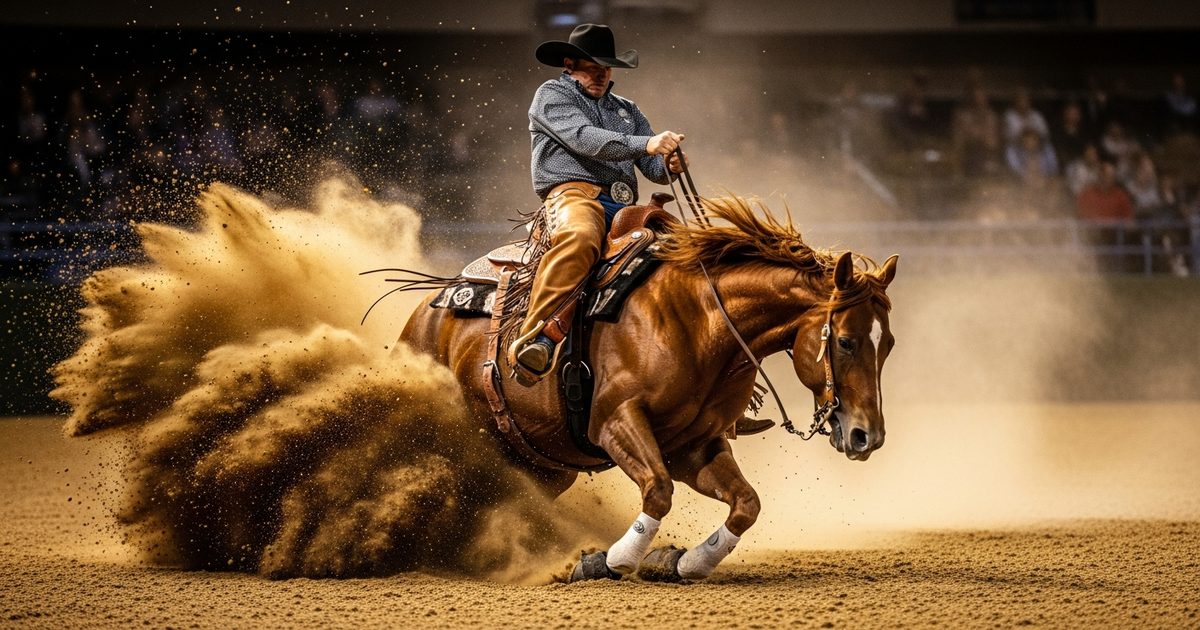
They call it the dressage of western riding, and they're not wrong. A well-trained reining horse performing a sliding stop in a cloud of arena dust is one of the most jaw-dropping sights in equestrian sport. But buying the right reining horse? That takes a little more than a cowboy hat and good intentions.
What Is a Reining Horse, Anyway?
Reining originated from the practical need for working cowboys to maneuver cattle at speed. Today it's an FEI-recognized sport (shown at the World Equestrian Games) with its own world federation — the NRHA (National Reining Horse Association).
A standard reining pattern includes:
- Sliding Stops — galloping at full speed then stopping dramatically, hind feet skating across the ground
- Spins — lightning-fast 360° pivots around the inside hind leg
- Rollbacks — a 180° turn immediately out of a stop, back into the lope
- Flying Lead Changes — switching leads at the lope mid-circle
- Circles — large fast and small slow circles showing speed control and collection
The Right Breed: Not Every Horse Is Built for This
The American Quarter Horse dominates reining worldwide — and for good reason. The breed combines a strong, low-set hindquarter, natural athleticism, and a level-headed temperament that lets horses work calmly at high intensity. Other viable options include:
- Paint Horse — genetically nearly identical to the Quarter Horse, fully competitive at all levels
- Appaloosa — less common but capable at amateur and lower levels
- Quarter Horse crosses — only worth considering if NRHA-proven bloodlines appear on both sides of the pedigree
When it comes to bloodlines, names matter. Look for sires like Gunner, Topsail Whiz, Spooks Gotta Whiz, Wimpys Little Step, Lenas Telesis, or Hollywood Dun It — these are proven reining dynasties whose offspring consistently show the natural talent for the discipline.
Understanding NRHA Scores: Your North Star
If a horse has competed at NRHA-sanctioned shows, it has score records — and those records are searchable online. Here's how to read them like a pro:
- Base score is 70 — every movement adds or subtracts from that baseline
- +0.5 to +1.5 per maneuver — good to excellent execution
- -0.5 to -1.5 — mistakes; -5 — major penalties like wrong lead or out of pattern
- Score 72+ — solid work; 74+ — strong; 76+ — serious competition horse
A horse consistently scoring 70–72 is well-trained for amateur/non-pro work. One hitting 74+ can do real damage in the show pen. Scores above 76? You're in the territory of expensive horses and professional riders.
Training Levels: What Are You Actually Buying?
- Young prospect (2–3 years, unstarted) — Good bloodlines, zero training. Cheapest entry point, but you're betting on genetics and investing years of professional training. Not for the impatient.
- Started and training level (3–5 years) — Knows the basics, maybe has a show or two. Ideal for ambitious non-pros who work with a trainer regularly.
- Finished non-pro / amateur horse (5–12 years) — Has a show record, NRHA scores, proven work ethic. Perfect for competitive non-pro riders who want to enter the ring without a multi-year training project.
- Babysitter / schoolmaster — An older experienced horse that knows the job and teaches YOU. Gold dust for reining beginners learning what a correct spin or stop actually feels like from the saddle.
What to Check at the Viewing
Reining horses work hard. Sliding stops hammer the hocks, stifles and hind feet. Spins twist the spine. Here's what deserves close attention:
- Hindquarters — deep, well-muscled hips and thighs are the engine. Flat or weak hindquarters mean limited natural ability.
- Hocks and stifles — feel for heat, swelling or stiffness before and after work. These are the reining horse's Achilles heel.
- Hooves — reining horses often have long toes and sliding plates. Check for balanced hoof shape; ask for photos without shoes if possible.
- Back — short and muscular, not long and weak. Run your hand down the topline and watch for sensitivity or flinching.
- Temperament — a quiet, soft eye and a willingness to settle are non-negotiable. Reining is a sport of trust; a tense or reactive horse won't let you ride it correctly.
Pre-Purchase Exam: Go Deep, Not Shallow
For a reining horse, a basic clinical PPE is not enough. Ask for:
- X-rays of both stifles and fetlock joints — where reining horses accumulate wear
- Ultrasound of tendons and suspensory ligaments — front and back
- Hoof evaluation — long-term sliding plates affect hoof shape and balance
- Spinal palpation and flexibility assessment — critical for any horse with a long show history
- Hock flexion tests — a non-negotiable for reining horses
And remember: the vet must be YOUR vet. Not the seller's regular vet, not the barn vet, and definitely not the seller's friend who "happens to be a vet." Independence matters.
Prices: What to Expect in Europe
- Unstarted young prospects: ~€3,000 – €10,000
- Training level / started horses: ~€8,000 – €25,000
- Finished non-pro horses: ~€20,000 – €60,000
- High-level open or elite horses: €60,000 – €150,000+
European reining horses are typically priced more affordably than comparable horses in the USA, but the selection is smaller. Italy has one of the strongest reining scenes in Europe (with top-flight breeders in Tuscany and Lombardy), followed by Germany, Switzerland, and France. Dream Quarters lists horses from across all these countries.
Europe's Key Reining Hubs – interactive map
Paperwork: What Should Come With the Horse
- AQHA or APHA registration papers (breed association)
- NRHA Lifetime Registration (required to compete at sanctioned shows)
- Competition score records (verifiable at nrha.com)
- Vaccination and dental passport
- Any vet records, treatment history or shoeing notes
Read next: Considering a reining-bred foal instead of a finished horse? Our foal-buying guide covers selection, pedigree, vet check and realistic costs.
Read next: With a reining horse, pedigree and aptitude matter — and contract clauses on warranted condition, PPE and show history make the difference. Our horse purchase agreement guide shows what must be in it.
Read next: Before you commit, do the honest math. Our guide how much does a Western horse cost? walks through realistic ranges for purchase, board, farrier, vet and insurance across DACH and Italy — May 2026.
Read next: You now know what to look for in a reining horse — but what bloodlines actually drive those sliding stops? Our Quarter Horse bloodlines guide breaks down the dominant reining, cutting and pleasure lines and what they mean genetically.
Read next: Cutting horses share similar athleticism and bloodlines — often at a lower price point. Our cutting horse guide for Europe explains the difference and how to choose the right discipline for you.
Ready to Find Your Reining Horse?
Buying a reining horse is one of the most exciting purchases in the western world — and one of the most consequential. Take your time, work with a knowledgeable trainer, never skip the pre-purchase exam, and prioritize soundness over flashiness.
Dream Quarters is where European western riders find their next horse:
- 👉 Browse all western horses for sale in Europe
- 👉 Find reining stallions with proven bloodlines
- 👉 Connect with a reining coach near you
"A great sliding stop starts years before you ever saddle up." — Dream Quarters Team