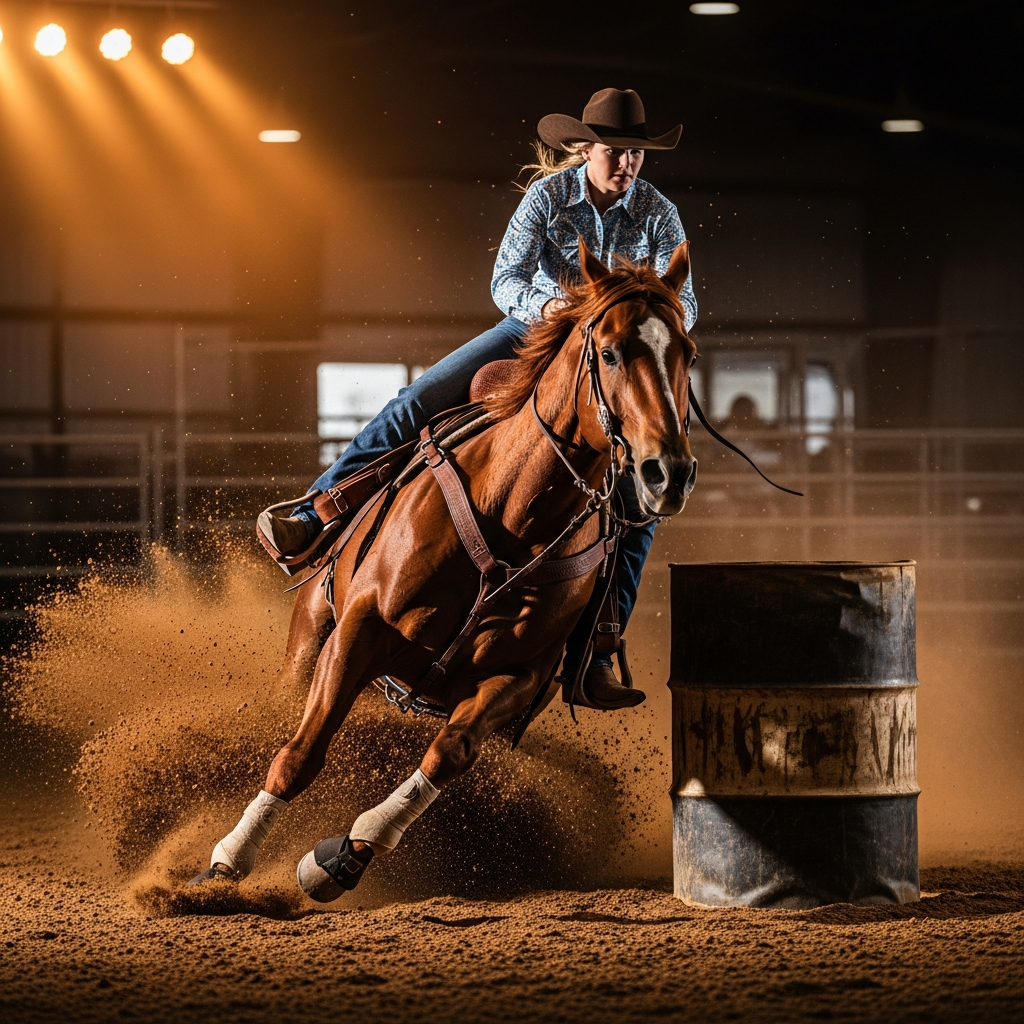
It starts innocently. You watch one barrel run — a friend's competition, a YouTube video, a live show — and see a horse fly around three barrels in 17 seconds. You replay it. Then replay it again. Then a third time, with a single thought: I want that. Welcome to barrel racing. There's no going back now.
As of May 2026. All prices indicative and for guidance only.
What barrel racing actually is
Barrel racing is a speed discipline from American cowboy tradition: horse and rider complete a cloverleaf pattern around three barrels in the fastest possible time. You start on either the right or left barrel first (determined by the draw), then the opposite barrel, then the far barrel — and back through the timing gate. Good horses run the pattern in 15 to 19 seconds. A knocked barrel typically costs five penalty seconds.
In Europe, the barrel racing community has grown steadily for years. Germany and Austria have active barrel leagues, the European Barrel Futurities (EBF) have established themselves as a credible competition series, and at major western events barrel racing is now a fixture. Anyone who thought this was purely an American pastime hasn't been watching the DACH scene.
The ideal barrel horse: what you're actually looking for
The ideal barrel horse is not the fastest horse in the barn. It's the horse with the best combination of speed, agility and rate — arguably the most important concept in barrel racing, and the one nobody explains in week one.
Rate is a horse's ability to slow down in a controlled way before the barrel, without the rider wrestling with the reins. A horse with good rate self-regulates before each turn, takes the barrel cleanly and fires back out on the exit side. A horse without rate runs through, knocks the barrel — and there go your five penalty seconds.
What a good barrel horse also needs:
- Hindquarter athleticism: The horse must be able to sit deeply on its hindquarters to execute clean turns. Weak hocks or stifles are a problem.
- Mental focus: Barrel racing is fast and loud — music, crowds, other horses. A nervous horse loses tenths of seconds through distraction.
- Soundness: Hocks, stifles and front feet bear extreme loads in barrel racing. Never buy without a thorough pre-purchase examination.
- Trainability: The horse needs to want to learn the pattern. A horse that fights its rider costs seconds you don't have.
Which bloodlines dominate barrel racing?
If you open a barrel horse pedigree and don't recognise any of these names, look more carefully:
- Frenchmans Guy: The definitive modern barrel sire. Born 1991, by Frenchman's Gold, he transformed both the American and European barrel markets. His offspring combine speed, agility, natural rate instinct and a trainability that works well for non-professional riders. If a horse is by Frenchmans Guy or by PC Frenchman (his most famous son), that's a very good sign.
- Dash For Cash: The foundation sire of modern speed events. Dash For Cash ran legendary quarter-mile times in the 1970s and founded an entire generation of speed horses. In virtually every top barrel horse in the world, Dash For Cash appears somewhere in the pedigree — comparable to Doc O'Lena's influence in reining.
- Tres Seis: Another influential speed sire, particularly known for passing on agility and mental willingness to work obstacles.
- Eyesa Special: Known for exceptional athleticism and speed — offspring appear frequently in the pedigrees of top open barrel horses.
The best barrel horses often combine speed bloodlines on the sire's side (Frenchmans Guy, Dash For Cash) with reining or cutting blood on the dam's side — for the combination of speed and the ability to work under pressure. For a full breakdown of Quarter Horse bloodlines in Europe, see our Quarter Horse bloodlines guide.
Age and training level: when a barrel horse is actually ready
Barrel racing horses reach their competitive prime between 6 and 12 years. That sounds old — but a barrel pattern demands physical maturity that younger horses simply don't have yet. Many of the best competition horses don't really hit their stride until 7 or 8 years old, when body and training finally come together.
That makes young prospects a double-edged sword. A three-year-old with a Frenchmans Guy sire sounds tempting — and may have genuine potential. But you're buying a projection, not a reality. Seeing whether the horse truly has rate, whether it stays mentally stable, whether the joints hold up under load — that can take 2 to 3 years to find out. It costs time, money and patience.
For barrel racing beginners, buying a trained, proven horse with a documented time record is far more sensible than a cheap prospect with a nice pedigree. You learn the discipline faster on a horse that already knows the job.
Where good barrel horses come from in Europe
Honest question, honest answer: the best barrel horses with top-level genetics almost always come from the USA.
Europe has built strong reining genetics over the past decade — but barrel racing only appeared in most European breeding programmes recently. Dedicated speed bloodlines (Frenchmans Guy, Dash For Cash) are significantly rarer on the continent than reining lines, and the number of breeders selecting specifically for barrel racing qualities is small but growing.
For beginners and club-level barrel riders: the European market does have suitable horses — Quarter Horses and Paint Horses with solid foundation training that work well for barrel racing even without top-tier speed genetics. These horses are affordable, often well trained, and great fun at club level.
For ambitious competitors: explore US import options. Good American horses reach Europe through specialist dealers and trainers — and transport is manageable with professional planning. Our guide to horse transport in Europe covers everything on logistics.
What a barrel horse should cost
Barrel horses in Europe are priced by training level and demonstrated performance. Here's a realistic breakdown:
- Prospect / young horse (untrained, good bloodlines): €5,000 – €12,000. You're buying potential. Budget 2–3 years of training time and costs on top.
- Trained barrel horse (non-pro capable): €12,000 – €30,000. Can run the pattern, has competition or solid training times. The most realistic entry point for ambitious leisure riders.
- Proven competition horse (open-level or futurity finalist): €30,000 – €80,000+. You're paying for demonstrated performance with time records and documented placings. Rare, expensive, and in high demand.
- US import: Add €3,000–€6,000 for professional air transport, quarantine and EU import costs on top of the purchase price.
For the full picture of what a western horse costs to keep monthly, see our guide how much does a western horse actually cost?
What you must check before buying
Barrel racing is one of the most joint-intensive disciplines in western riding. Tight turns at full speed put extreme loads on hocks, stifles, fetlocks and front feet. A thorough pre-purchase examination is even more important here than usual — and it needs specific focus:
- Hocks: Spavin x-rays are mandatory. Early arthritic changes can progress rapidly under barrel racing loads.
- Stifles: High-speed directional changes put enormous stress on these joints. Request x-rays here too.
- Front feet and fetlocks: Navicular risk is elevated in barrel horses, especially on hard footing. Radiograph both front and hind feet.
- Back musculature and lumbosacral area: Barrel horses work extremely hard with their hindquarters. Tension and issues in the lumbar region are common in active competition horses.
- Hoof quality: Bars, sole, frog condition — all relevant to the horse's ability to handle intensive training.
Use an experienced equine vet with western sport knowledge. Our pre-purchase examination guide explains what to do before and after the exam.
Trial ride and timing the pattern
With a barrel horse, the trial ride is not a formality — it's a performance test. Go to the seller's yard, ride the horse in the arena, then: timer on, let the horse run. Have it run twice and compare.
Reference times (standard arena, approximately 18 × 27 metres):
- Under 16 seconds: Open-level potential, professional range
- 16–17 seconds: Very good for advanced non-pros
- 17–19 seconds: Good for club level and ambitious beginners
- Over 19 seconds: Leisure level — perfectly fine if that's your goal
Does it find the barrels on its own or do you have to steer? Does it drive hard out of the turns or lose momentum on the exit? All of that is information you can't get anywhere else.
Training: what you need before buying a barrel horse
An honest moment: the world's best barrel horse cannot ride a beginner through a clean pattern. Barrel racing takes timing, body feel, balance through the turns and the ability to release the horse at exactly the right moment — no horse can do that for you.
If you've never ridden barrel racing before: find a barrel trainer on Dream Quarters or book a clinic with someone who genuinely knows the discipline. Learn on a school horse or calm all-rounder before investing in a specialised horse. Our guide on how to find the right western trainer helps you get started.
What you'll find in Europe — and what you won't
The good news: the European barrel market is growing. More active breeders, more competition opportunities and more experienced trainers than five years ago.
The honest news: for genuine top-tier barrel genetics (Frenchmans Guy sons, PC Frenchman descendants, Tres Seis blood in the first two generations), you often need to search deep in the European market or consider importing.
Dream Quarters shows you current listings from Germany, Austria, Switzerland and Italy — Quarter Horses and Paint Horses suitable for barrel racing, with direct seller contact and complete papers. What the purchase contract should contain is in our purchase agreement guide.
Frequently asked questions about buying a barrel racing horse
How much does a good barrel racing horse cost in Europe?
A trained barrel horse in Europe costs between €5,000 and €30,000 depending on training level. Green prospects or young horses start at €5,000–€12,000. Solid non-pro horses with competition experience run €12,000–€30,000. Proven competition horses with documented time records sit well above €30,000 — often €40,000 to €80,000 or more. US imports add transport, import duty and quarantine costs, typically €3,000–€6,000 on top.
Can I use a reining Quarter Horse for barrel racing?
In principle yes, but rarely optimal. Reining Quarter Horses have the athleticism — but barrel racing demands specific rate ability (the capacity to slow down in a controlled way before the barrel), explosive directional changes and a very specific mental approach to the job. A properly trained barrel horse with speed bloodlines (Frenchmans Guy, Dash For Cash) typically outperforms a reining horse at the barrels. If you already have a good reining horse, talk to a barrel trainer for an honest assessment before making a decision.
Which bloodlines are typical for barrel horses?
The dominant bloodlines in modern barrel racing are: Frenchmans Guy (the most influential barrel sire of the modern era), Dash For Cash (the foundation sire of modern speed events), PC Frenchman (son of Frenchmans Guy), Tres Seis and Eyesa Special. Many top barrel horses combine speed bloodlines on the sire's side with athletic reining or cutting lines on the dam's side. Look for two or three of these names in the first two generations of the pedigree.
Do I have to import a barrel horse from the US?
Not necessarily — but for high-level competition horses, importing from the US remains the most common route in Europe. Serious barrel genetics (Frenchmans Guy lines, Dash For Cash descendants) are significantly rarer in Europe than reining genetics. For leisure and club-level barrel riders, European options are growing — both from dedicated barrel breeding programmes in Germany and Austria and from the general Quarter Horse market. Dream Quarters lists current European options.
What should the pre-purchase exam focus on for a barrel racing horse?
For a barrel horse, the pre-purchase exam should focus specifically on: hock joints (spavin x-rays), fetlock and stifle joints (high stress from directional changes), front feet and lower leg (navicular risk on hard footing), back musculature and lumbosacral area, and hoof quality (bars, sole, frog condition). Always request radiographs of the key joints — an equine vet with western sport experience is the best choice. If the horse is experienced, ask for a timed barrel run during the viewing.
Your barrel horse — and where to start
Barrel racing grabs hold and doesn't let go. The challenge when buying: barrel horses with genuine speed genetics are rarer in Europe than reining horses — but they exist. Patient searching, thorough vetting and a trial run with a barrel trainer will get you there.
Dream Quarters shows Quarter Horses, Paint Horses and western horses from Germany, Austria, Switzerland and Italy — direct seller contact, complete papers.
👉 Find barrel-suitable horses on Dream Quarters
👉 Find barrel trainers and coaches on Dream Quarters
"Three barrels. One horse. Roughly 17 seconds that change everything." — Dream Quarters Team