The US-import dream is as old as Western riding in Europe: somewhere in Texas stands the perfect horse, supposedly at half the price. The truth is more complicated — honestly calculated, little of that price advantage survives. This guide shows what an import really costs, how the six to ten weeks unfold, the two customs numbers you need to know — and when you are better off buying on this side of the Atlantic.
Why import at all?
The USA is the largest Quarter Horse market in the world. For very specific requirements — a finished cutting horse with a show record, a mare from a particular dam line, an offspring of a stallion that never bred in Europe — the depth of supply over there is simply greater. And for finished, trained horses, the sticker prices are sometimes lower than here.
On Dream Quarters, roughly one listing in twenty mentions a US import — so the horses do cross the pond. But behind most of them are experienced barns and dealers who have walked this road many times. For a first-time buyer the math looks different, and that is exactly what we are going to work through.
When importing pays off — and when it doesn't
Importing pays off when you are after something Europe genuinely doesn't have:
- Verifiable show records in cutting, reined cow horse or high-level reining — the density of finished, show-proven horses is far higher in the US
- Specific genetics: a particular dam line, or offspring of a sire whose get rarely comes up for sale here
- Proven broodmares — the foundation European breeding itself was built on
Importing does not pay off as a bargain hunt. Between you and that tempting price stand five-figure costs, a long-distance purchase, and warranty rights that are practically unenforceable across the Atlantic. And the biggest point: much of what people used to fly over for has long been standing here. The great reining and cutting lines — Gunner, Wimpys Little Step, Metallic Cat — have had sons and grandsons standing at stud in Europe for decades. Our bloodline guide explains what those lines mean genetically.
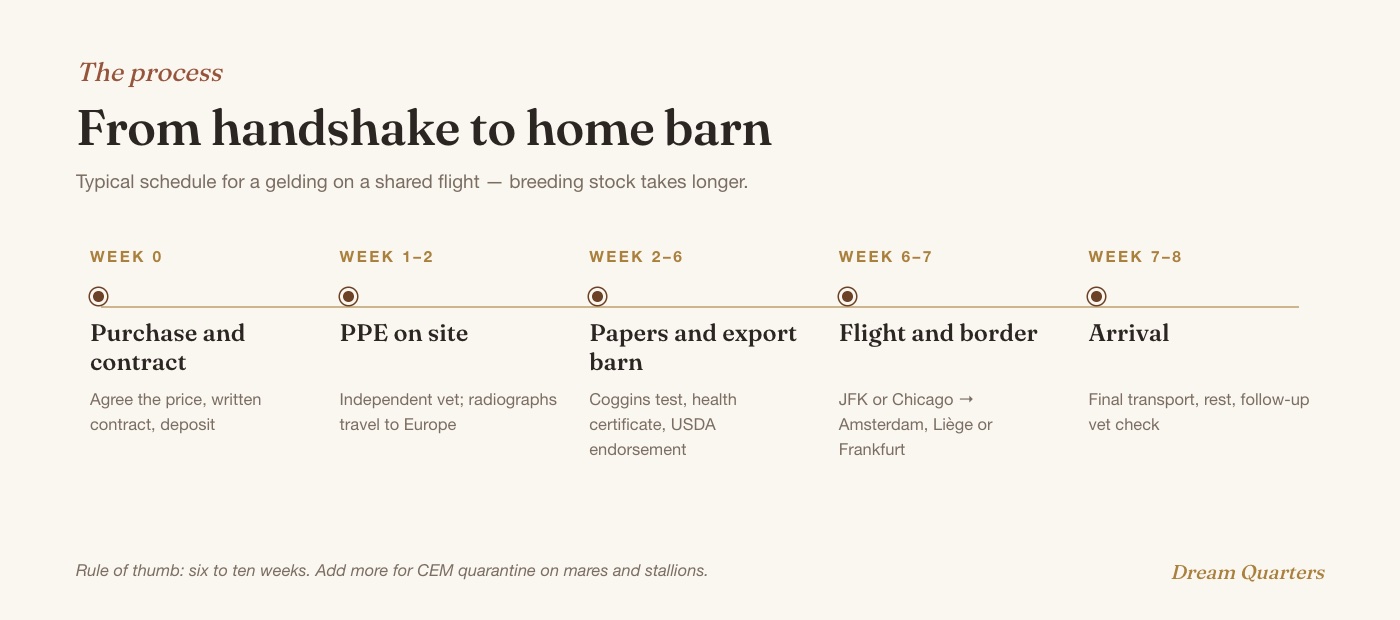
The process: from deposit to barn aisle
Step 1: Find and verify
Reputable means verifiable. Show results can be checked in the NRHA, NCHA and AQHA databases — a seller who dodges specific questions is one seller too many. Insist on a live video call where the horse is shown in real time, not just edited clips. For a first import, a bloodstock agent with references is usually worth the money: they know the barns, negotiate, and run the payment through escrow. Five to ten percent commission is customary.
Step 2: The pre-purchase exam
The same rule applies in the US as here: the vet works for you, not for the seller — so never use the seller's own barn vet. The radiographs travel digitally to your vet in Europe, who reads them to local standards before you sign anything.
Read next: What a full PPE covers, what it costs and which findings are deal-breakers — our pre-purchase exam guide walks through it step by step.
Step 3: Papers and export barn
Before departure come the Coggins test (for Equine Infectious Anemia), the health certificate and the USDA endorsement — the official stamp of the US veterinary authority. Plan on roughly a month in an export barn near the departure airport, where the shipper coordinates tests and appointments. Geldings travel simplest. Mares and stallions add CEM testing and sometimes longer isolation — your shipper knows the current protocol.
Step 4: The flight
Departures run from New York, Chicago, Miami or Los Angeles; arrivals are mostly Amsterdam, Liège or Frankfurt. In New York, horses wait at the ARK, a dedicated animal terminal at JFK. Economy means three horses share one air stall, like a roomy three-horse trailer. A professional groom flies along, checking hay and water. Most pros will tell you: a horse flies calmer than it rides twelve hours in a trailer.
Step 5: Arrival and settling in
After landing come the veterinary border inspection and customs clearance — in practice, both handled by your customs agent. Then a transporter brings the horse home; our guide to horse transport in Europe covers that last leg. And then: rest. Time zones, climate, different hay, a new herd — give the horse two to four weeks to arrive before the work starts.
The honest math
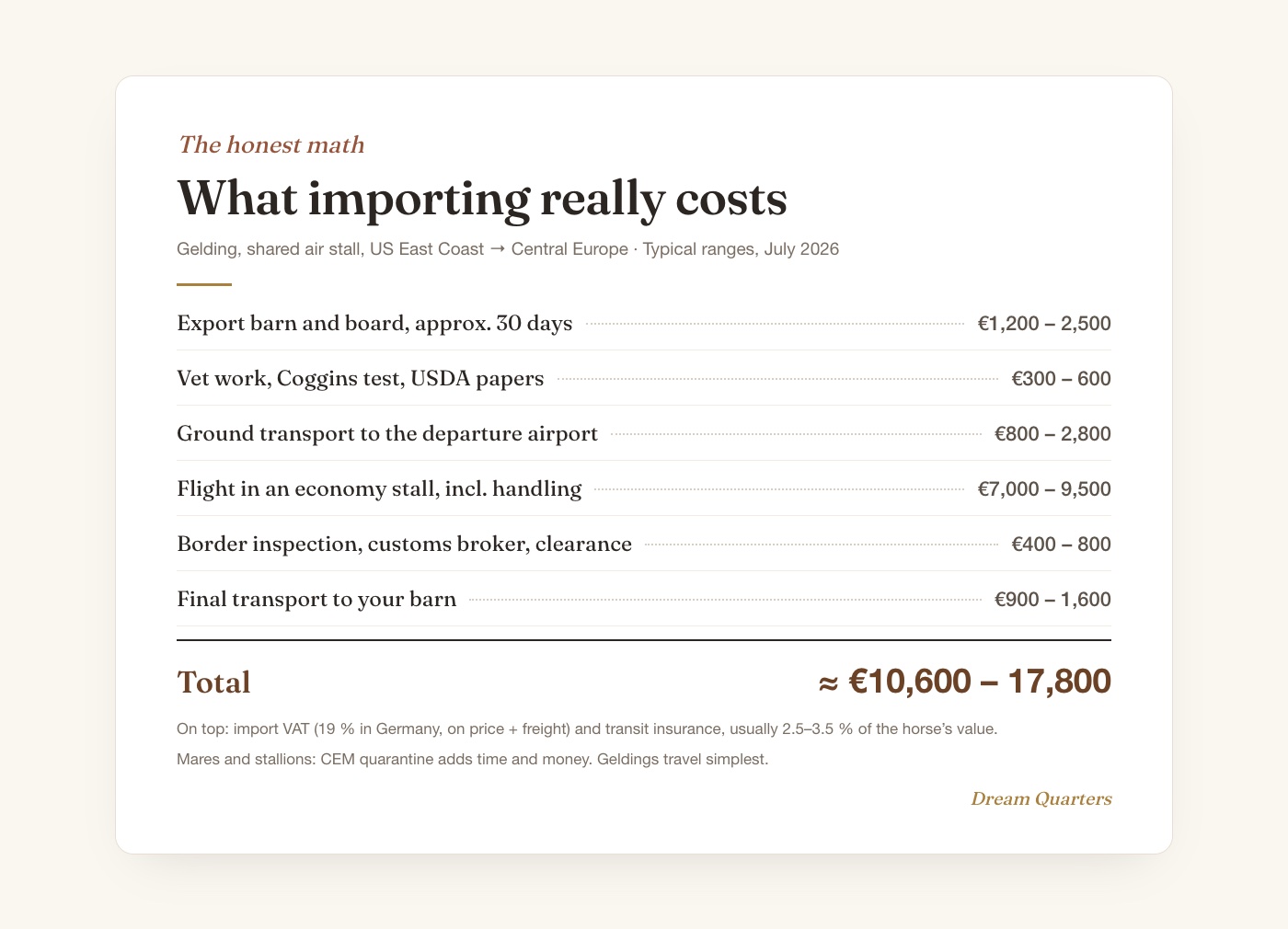
Let's run the numbers. A gelding for $25,000 in Oklahoma — around €22,000, depending on the day's rate. Add import costs at the middle of the ranges above, say €13,000. Import VAT: 19 % on price plus freight in Germany, another €6,000 or so. In the end, a good €40,000 is on the slip before the horse snorts in your barn aisle for the first time. The $25,000 bargain isn't one — it's a €40,000 horse that has to be worth that price.
Add transit insurance: 2.5 to 3.5 % of the horse's value for stall-to-stall cover is customary. On anything above €15,000, it is not worth a debate.
Read next: What a Western horse costs after the purchase — board, farrier, vet, insurance — our guide What does a Western horse cost? lays it out honestly.
Customs and import VAT: the two numbers to know
- Customs duty: for pure-bred breeding animals with papers — which registered Quarter Horses with an AQHA pedigree generally are — the rate is 0 %. Without that proof, up to 11.5 % applies. Your customs agent handles the classification.
- Import VAT: due on purchase price plus freight to the EU border — 19 % in Germany, 20 % in Austria, 22 % in Italy. Buying as a business, you can reclaim it as input tax; for private buyers it is a real cost.
Both figures: as of July 2026, no guarantee — binding answers come from customs or from your shipper, who handles clearance anyway.
The risks nobody likes to talk about
- You are buying sight unseen. Every sales video shows the best five minutes. What it doesn't show: loading, the farrier, a bad day. Video call, references, PPE — or fly over yourself. A plane ticket costs a fraction of a bad purchase.
- Wire fraud is real. Fake ads with stolen photos, deposits to private accounts — and the nastiest variant: hijacked email threads where "new bank details" appear just before payment. Always verify account details by phone, on a number you looked up yourself.
- Warranty effectively ends at the Atlantic. US sale contracts often sell as is. Litigating a defect over there later is unrealistic for a private buyer. All the more weight falls on the PPE and the contract — our horse purchase contract guide shows what belongs in it.
- The transition is work. Different climate, different hay, new germs, new herd. Plan four to eight weeks until the horse has truly arrived — and don't expect the horse from the sales video during that time.
- The exchange rate works for you or against you. Between handshake and payment, a dollar price can move by hundreds of euros. Agree early on who carries the currency risk.
Papers: AQHA transfer and the equine passport
With the purchase, the horse comes with a Transfer Report, which the AQHA uses to transfer the horse into your name — you need your own membership for that. The export papers themselves run through the US veterinary authority USDA APHIS; your shipper organizes this. Once in Europe, the horse needs an equine passport, issued by your breed association — for Quarter Horses in Germany, the DQHA. No passport, no transport, no shows, no barn move.
Or: the horse is already standing in Europe
The most honest advice in this text: fly only after you have searched on this side. Dream Quarters lists more than a thousand Western horses from over a dozen European countries — from foals to finished show horses, and quite a few are US imports themselves, with flight, customs and papers already done. The breeders behind them will happily answer your pedigree questions today rather than tomorrow. A horse you can visit twice, test-ride and vet locally beats the import nine times out of ten — not for dreaming, but for buying.
Frequently asked questions
How much does it cost to import a horse from the USA to Europe?
For a gelding on a shared flight from the US East Coast: roughly €10,600 to €17,800 — export barn, testing, flight, customs handling and final transport. Add import VAT (19 % in Germany on price plus freight) and insurance. A $25,000 horse ends up at a good €40,000.
How long does the import take?
From purchase to barn aisle, typically six to ten weeks: PPE, about 30 days of export barn with tests and papers, flight, border inspection, final transport. Mares and stallions often take longer because of CEM testing.
Does the horse have to go into quarantine?
Not the weeks of EU quarantine people imagine: the isolation happens before departure, in the US export barn. After landing come the veterinary border inspection and customs clearance — with clean papers, the horse continues straight toward its new home.
Can I buy a horse sight unseen?
Possible, but the single biggest risk of importing. Minimum: live video call, verifiable show and breeding records, a PPE by an independent vet, payment via escrow or an agent. Better: fly over — the ticket costs a fraction of a bad purchase.
How much customs duty applies when importing a horse?
0 % for pure-bred breeding animals with papers, otherwise up to 11.5 %. Registered Quarter Horses with an AQHA pedigree generally clear duty-free. Import VAT, however, always applies.
Summary
A US import is not a bargain, it is a project: six to ten weeks, five-figure side costs, and a purchase carried by the PPE, the contract and a reputable shipper. It pays off for genetics and training Europe genuinely doesn't have — and almost never for the price alone. Check both, and you will buy right in the end: over there, or over here.
Dream Quarters helps with both: