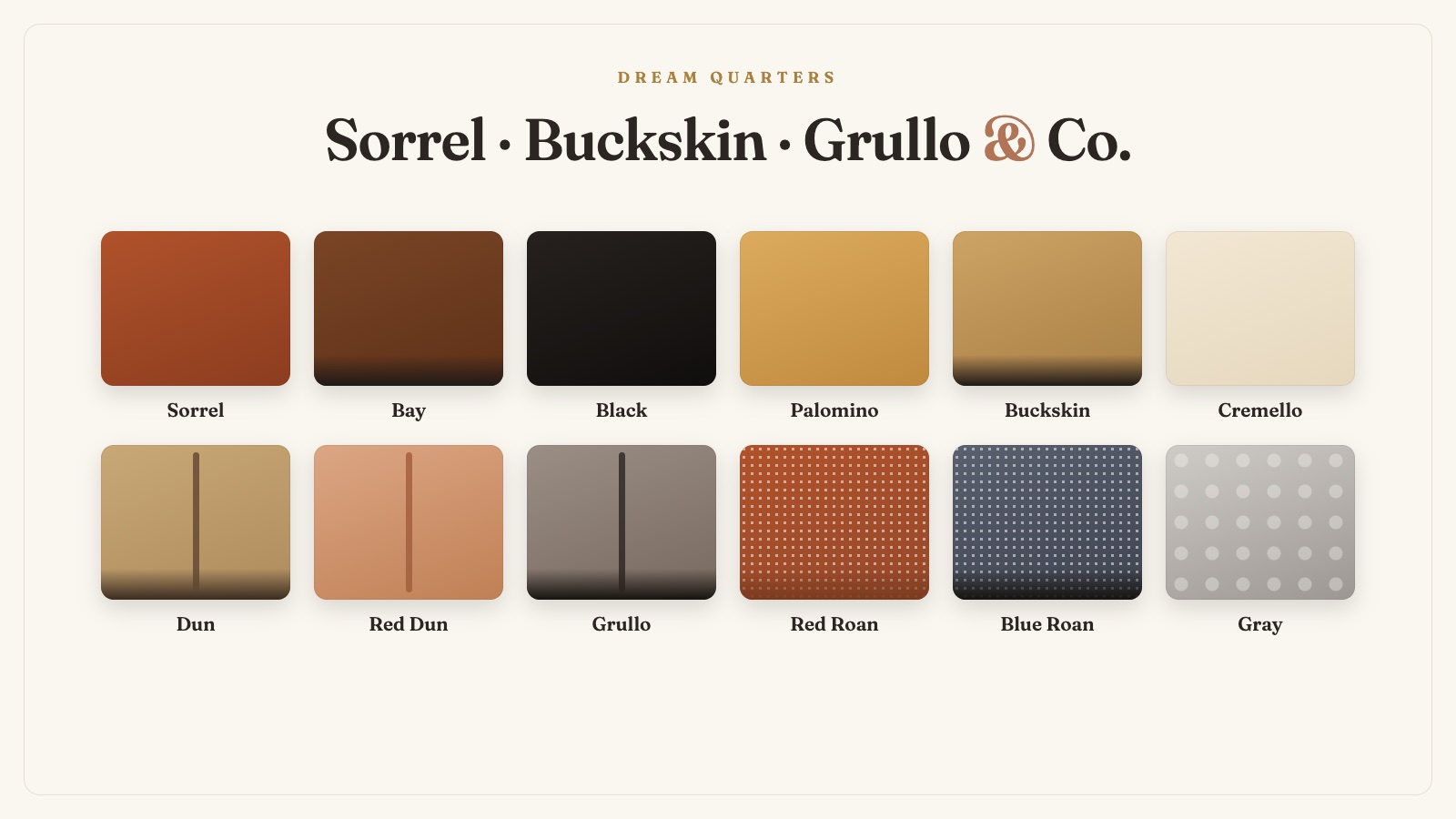
Nobody likes to admit it, and everybody does it: the first thing you notice about a horse is its color. No one scrolls through sale horses thinking "interesting radiographs" — we get stuck on a mouse-gray grullo and are briefly not of sound mind. This guide brings order to the Quarter Horse color kitchen: what exists, how it's inherited, what color should cost when you're buying — and where to look twice.
Genetically, there are only two horse colors
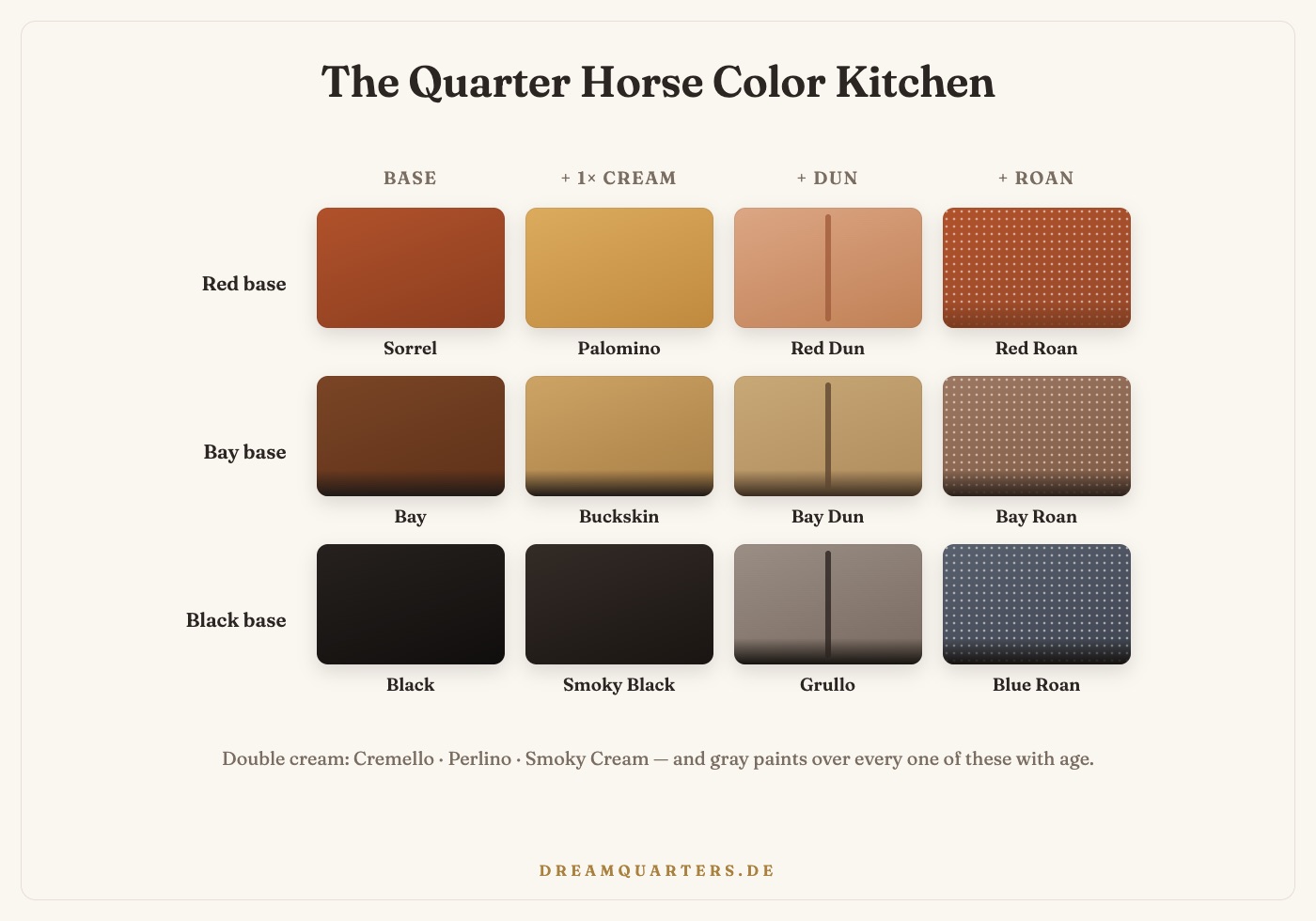
Perhaps the best party fact in horse genetics: there are exactly two base colors — red and black. Every horse on earth is, under the hood, a chestnut or a black. Everything else, from palomino to blue roan, is switches and filters layered on top: the agouti gene pushes black to the edges (mane, tail, legs — voilà, a bay), cream lightens, dun adds wild-horse decor, roan sprinkles white hairs, and gray paints over everything with age. Nature has two base tones and a handful of Photoshop filters — that's all it needs.
The classics: sorrel, bay, black
- Sorrel — the copper-red chestnut and by far the most common Quarter Horse color: roughly a third of all AQHA registrations. The difference from chestnut in Western parlance is simply shade — sorrel lighter, chestnut darker to liver. The base of everything red.
- Bay — brown body, black mane, tail and legs. That's agouti at work: black is present but only allowed at the edges.
- Black — far rarer in the Quarter Horse than sale ads suggest. Many "blacks" are sun-bleached dark bays or smoky blacks; a true black stays black in July instead of shimmering rusty brown.
The cream family: gold, sand and the pale siblings
A single cream gene turns the three classics into the colors the internet was invented for:
- Palomino — cream on chestnut: golden body, flaxen mane. Hollywood built entire careers on this color.
- Buckskin — cream on bay: sandy body, black points. The color that demonstrably makes buyers click faster than their brain can shout "vet check first!"
- Smoky black — cream on black, and you see: almost nothing. The undercover agent of colors. Looks like a (often slightly sun-burnt) black, but happily passes cream along — which is how those palomino foals "nobody can explain" happen.
- Cremello & perlino — double cream: ivory coat, pink skin, blue eyes. Not albino (horses don't have that), just diluted twice. Needs sunscreen on the nose in summer — that's not a punchline, that's barn life.
The dun family: factory-fitted wild horse decor
Dun is the filter with history: it lightens the body and applies the primitive markings already visible in cave paintings — the dark dorsal stripe from withers to tail, zebra bars on the legs, sometimes a shoulder blade. On chestnut it makes a red dun, on bay a bay dun — and on black, the color this article gets clicked for:
Grullo (pronounced "GREW-yo", Spanish; mares are properly grulla): mouse-gray to slate coat, black mask, black points, dorsal stripe. Elegant in sober daylight — in the golden hour of a sales video, this color has toppled more sensible decisions than any other. We don't judge. We just budget.
The classic mix-up: buckskin or dun? Both sandy, both black-legged — but the buckskin carries no dun gene and thus no true dorsal stripe. The criterion is the primitive markings, not the shade. And yes, a horse can carry both: folk taxonomy calls that a dunskin, and color genetics shrugs contentedly.
Roan: powdered sugar, once — forever
Roan sprinkles white hairs evenly across the body while leaving head and legs dark — as if the horse had elegantly fallen into powdered sugar, permanently. On chestnut that's a red roan, on bay a bay roan, on black a blue roan — which isn't blue, but shimmers steel-gray enough that the name stuck. Important when buying: a roan stays roan for life. Anyone promising you a "young roan foal, will lighten a lot!" is confusing roan with the next chapter.
Gray: the one-way street
A gray isn't born, it becomes — dark at birth, it lightens with every coat change, from dapple gray to marble statue. Gray is not a shade but a process, and it paints over every color above. In the Quarter Horse it's much rarer than in Arabians or Lipizzaners. The honest part: older grays develop melanomas above average (usually benign, often under the tail). No reason to panic, but a reason to ask specifically during the pre-purchase exam.
What should color cost?
Straight talk: the market really does pay premiums for buckskin, grullo and blue roan — the same training in a "boring" sorrel is often the better deal. Because the uncomfortable truth is: color doesn't ride. No judge on earth gives half a point for grullo, no dorsal stripe stops a cow, and the spin doesn't get faster because the mane flows golden. The buying order remains: health, conformation, training, pedigree — and then you may fall in love. How pricing works overall is covered in our Quarter Horse buying guide.
And if it must be a dream color: the search understands you. Buckskins, grullos, roans, palominos — one click shows you what's currently standing in Europe. The map adds the location.
Color breeding for the impatient
Color inheritance is poker with open cards — you know the odds and are surprised anyway. The three most useful rules:
- Palomino × sorrel: roughly half palomino, half sorrel. The classic, no guarantees.
- Cremello × sorrel: 100% palomino. The only guarantee certificate in the whole color poker — which is why cremello stallions are so sought after in palomino breeding.
- Buckskin × buckskin: does not reliably make buckskin, but a mixed bag including the chance of double cream. If you breed for color, test the genes instead of rolling dice.
Reputable listings state which genes a stallion actually carries — the breeding stallions on Dream Quarters show pedigree and color at a glance. How to choose a stallion beyond color is covered in the stallion guide; what to watch for in youngsters, in the foal guide.
Color and health: where to look closely
- Cream, dun, roan, classic gray: medically unremarkable. Color alone doesn't make a horse sick.
- Frame overo (Paint circles): two copies mean the fatal lethal white syndrome in the foal. Anyone breeding toward Paint Horses tests first — no exceptions.
- Appaloosa patterns: a double LP gene brings night blindness; details in the Appaloosa guide.
- Grays: see above — melanomas with age; raise it at the vet check.
The good news: lab tests for all of this cost about as much as a halter — for instance at the UC Davis Veterinary Genetics Laboratory. A few mane hairs suffice. For "rare" colors with a premium: test first, pay second.
Trivia to show off: the old "white rule"
Until the early 2000s, too much white could literally cost a Quarter Horse its papers: foals with large white markings — "cropouts" — were refused AQHA registration, no matter how noble the parents. From exactly these outcasts, a breed association of their own was founded in 1962: the American Paint Horse. The rule only fell for good in 2004. So next time someone tells you color debates are a matter of taste: in this industry they have split entire stud books.
Frequently asked questions about Quarter Horse colors
What is a grullo?
The dun variant on a black base: mouse-gray to slate coat with black mask, black legs and a dorsal stripe. Mares are properly called grulla. Not to be confused with gray — a grullo keeps its color for life.
What's the difference between buckskin and dun?
The shade can be nearly identical — the genes and markings decide. A buckskin (cream gene) has no true dorsal stripe; a bay dun (dun gene) carries the stripe and often zebra bars on the legs. A horse carrying both is colloquially a "dunskin".
How does a blue roan happen?
The roan gene on a black base: white hairs in a black coat create the steel-gray shimmer. Head and legs stay dark, and — unlike gray — the color remains stable for life.
What is the most common Quarter Horse color?
Sorrel, the copper-red chestnut — about a third of all AQHA registrations. It's literally the most common horse color in the world, because the Quarter Horse is the world's largest breed.
Do foals change color?
Do they ever. Foal coats are notorious liars: grays are born dark, duns look dull at first, and many a "black" turns out dark bay after the first shed. Only a DNA test or patience settles it — for an expensive color promise, prefer the former.