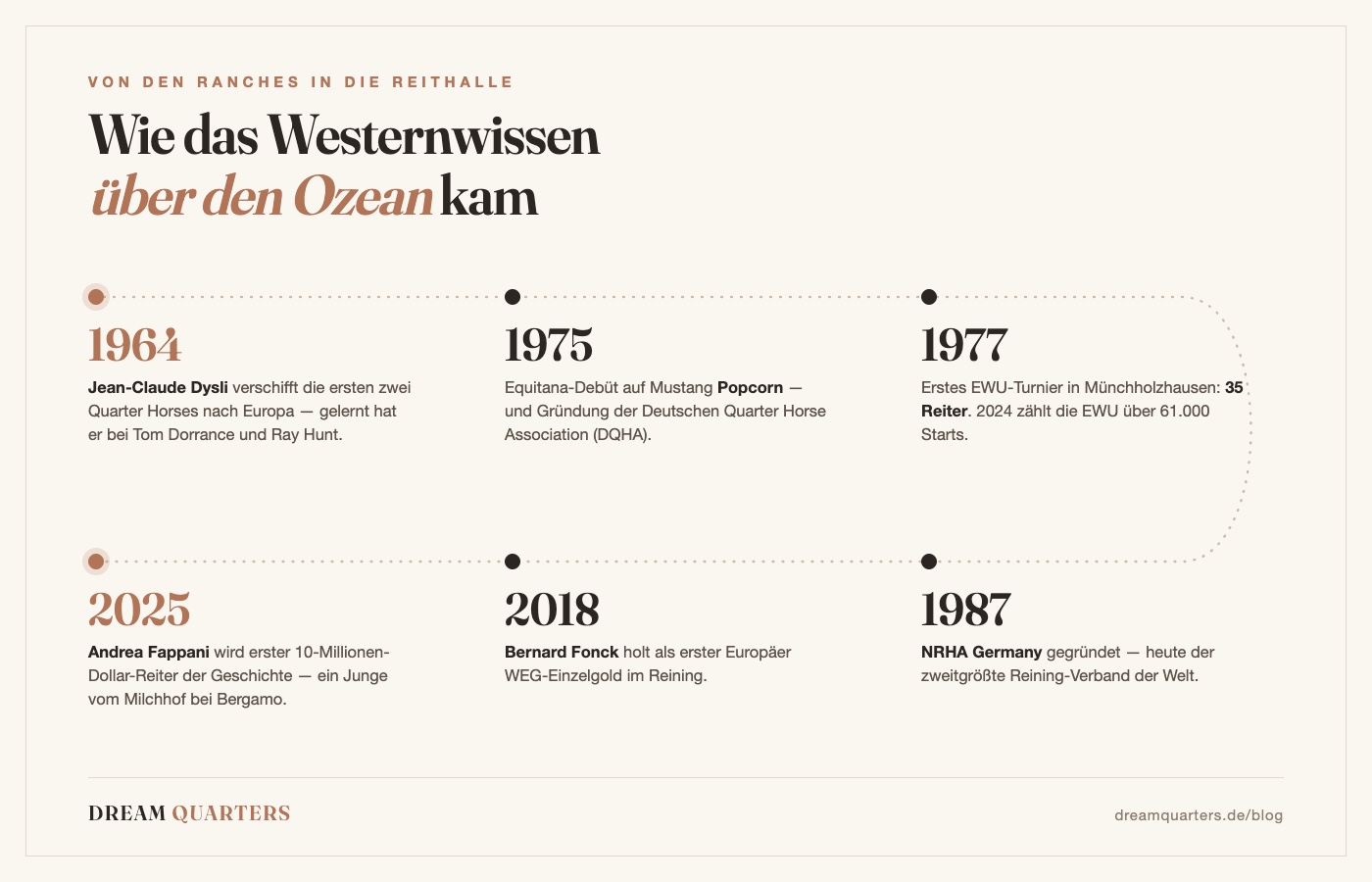
Ask your trainer where their knowledge actually comes from. If they are any good, the trail does not end with their own teacher. It leads back across the Atlantic, onto cattle ranches in Ohio and Oregon — and at some point you are looking at a dated black-and-white photograph: May 25, 1964, a Quarter Horse stallion on the deck of a ship bound for Europe. This is the story of the great western trainers, the quiet revolution they started, and the detour their knowledge took on its way into your riding arena.
Ohio, 1966: the father of modern reining was no Texan
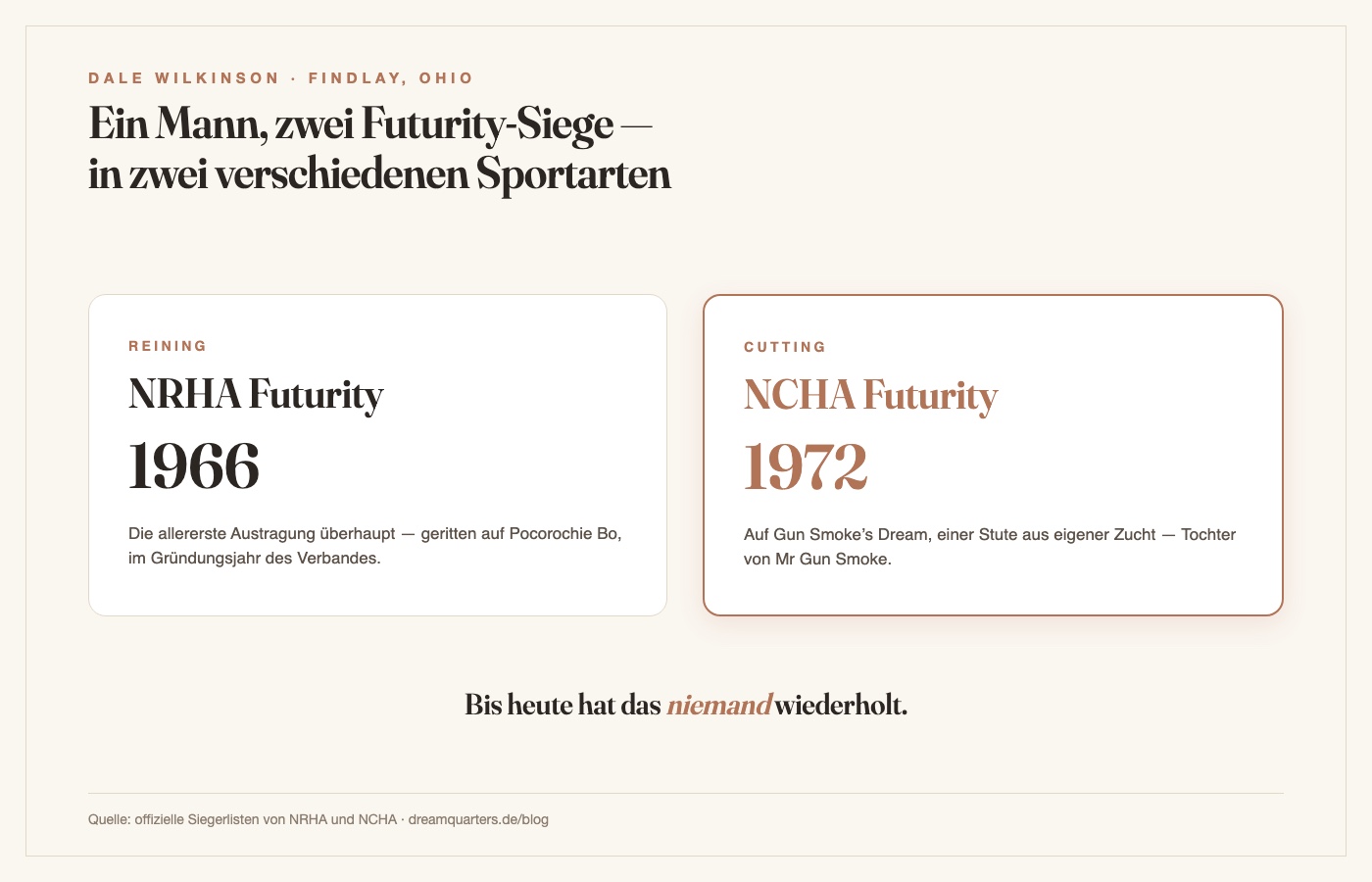
You have to start where the sport took its shape — and that is not Texas. The National Reining Horse Association was founded in 1966 in Coshocton, a small town in Ohio, and its first Futurity was won that same year by a farm boy from the area: Dale Wilkinson, who had started riding horses for pocket money at fourteen.
"Invented" is the wrong word, and Wilkinson would never have used it. Reining had long existed as a ranch class. What Wilkinson did was mold it into a sport: cadenced, stepping turnarounds instead of dragged-around turns, a draped rein instead of constant contact, symmetrical circles, smooth sliding stops. To this day the NRHA calls him the "Father of Modern Reining", its lifetime-achievement award carries his name — and when the association opened its Hall of Fame in 1986, Wilkinson was the very first name in it.
How deep his horsemanship ran shows in a feat nobody has repeated since: Wilkinson is the only person ever to win both the NRHA Futurity and the NCHA Futurity in cutting. The latter he took in 1972, an Ohio man deep in Texas-dominated cutting country — on Gun Smoke's Dream, a mare of his own breeding. Her sire was Mr Gun Smoke. If that name rings a bell: he is the very stallion our story about reining bloodlines begins with. The western world has always been a village.
One more thing belongs to this man: from the mid-seventies he helped build the famous equestrian program of the University of Findlay and taught students there for years — without ever being on the payroll. Remember that detail; it returns at the end.
The quiet revolution: Dorrance, Hunt and a horse named Hondo
While a sport was taking shape in Ohio, something quieter — and, in hindsight, bigger — was happening farther west. On the ranches of the Northwest worked a small, bow-legged Oregon stockman named Tom Dorrance, who read horses like nobody else. His most famous line is a question: "What happened, before what happened happened?" — what went on before the thing the horse is now being blamed for? Dorrance avoided cameras, rarely taught in public and did not write his slim book until he was 77. That his ideas traveled the world anyway is owed to a young cowboy who showed up at his door in the winter of 1960/61 with a dangerous horse.
Ray Hunt was riding the rough string in those days — the horses nobody else wanted — and the only horse he owned was a colt named Hondo who bit, kicked and bucked. One year under Dorrance's eye later, Hondo won a working cow horse class at the Cow Palace in San Francisco, shown in a hackamore. All his life Hunt said that everything he knew had started with that one horse. And he turned it into a profession that did not yet exist: decades before anyone said "natural horsemanship", he traveled the country giving clinics, started strangers' colts in days rather than weeks without "breaking" them, and opened every clinic with the same sentence: "I'm here for the horse — to help him get a better deal."
If you are thinking of "The Horse Whisperer" right now: right direction, wrong name. Author Nicholas Evans made it clear that his novel was inspired not by the showmen of the nineties but by Buck Brannaman — a student of Ray Hunt. The soft way with horses is no marketing invention of those years. It comes off cattle ranches, a full generation earlier.
The twist: a Swiss civil engineer brings western riding to Europe
Here the story takes its finest turn. The man who carried all of this across the ocean was no cowboy — he was a civil engineer. Jean-Claude Dysli, born in 1935, took his ETH Zurich degree in 1958 at the top of his class and had laid his riding foundation, of all places, in the circus, as a student of Fredy Knie senior. In the early sixties he went to California to continue his studies, wandered into a rodeo at the Cow Palace — the same hall where Hondo won, if you are keeping count — and got stuck: seven years as a working cowboy, from 1969 with a ranch of his own. His formative teachers: Tom Dorrance and Ray Hunt. The same two men. The horsemanship line running through European arenas today begins exactly there.
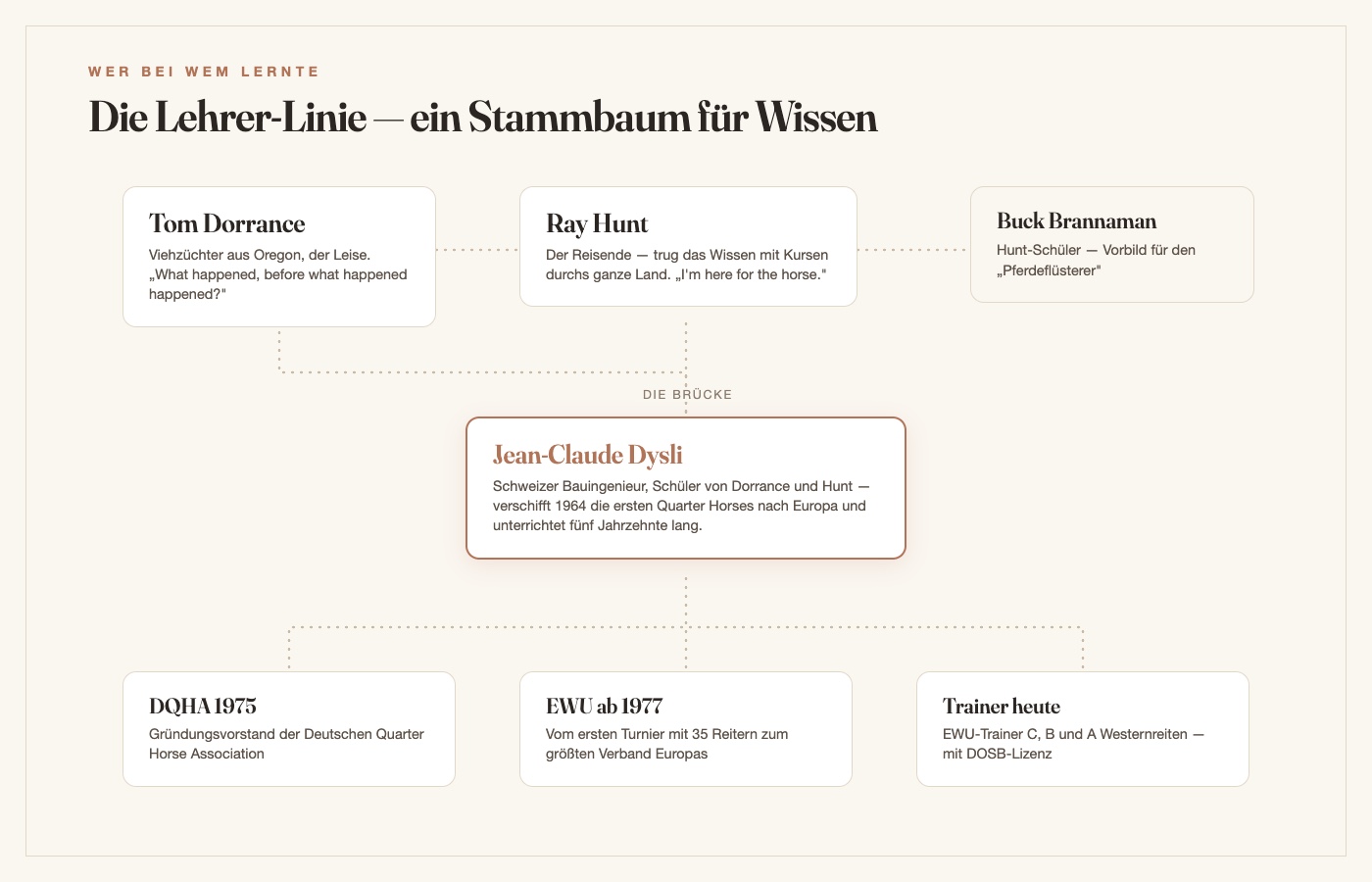
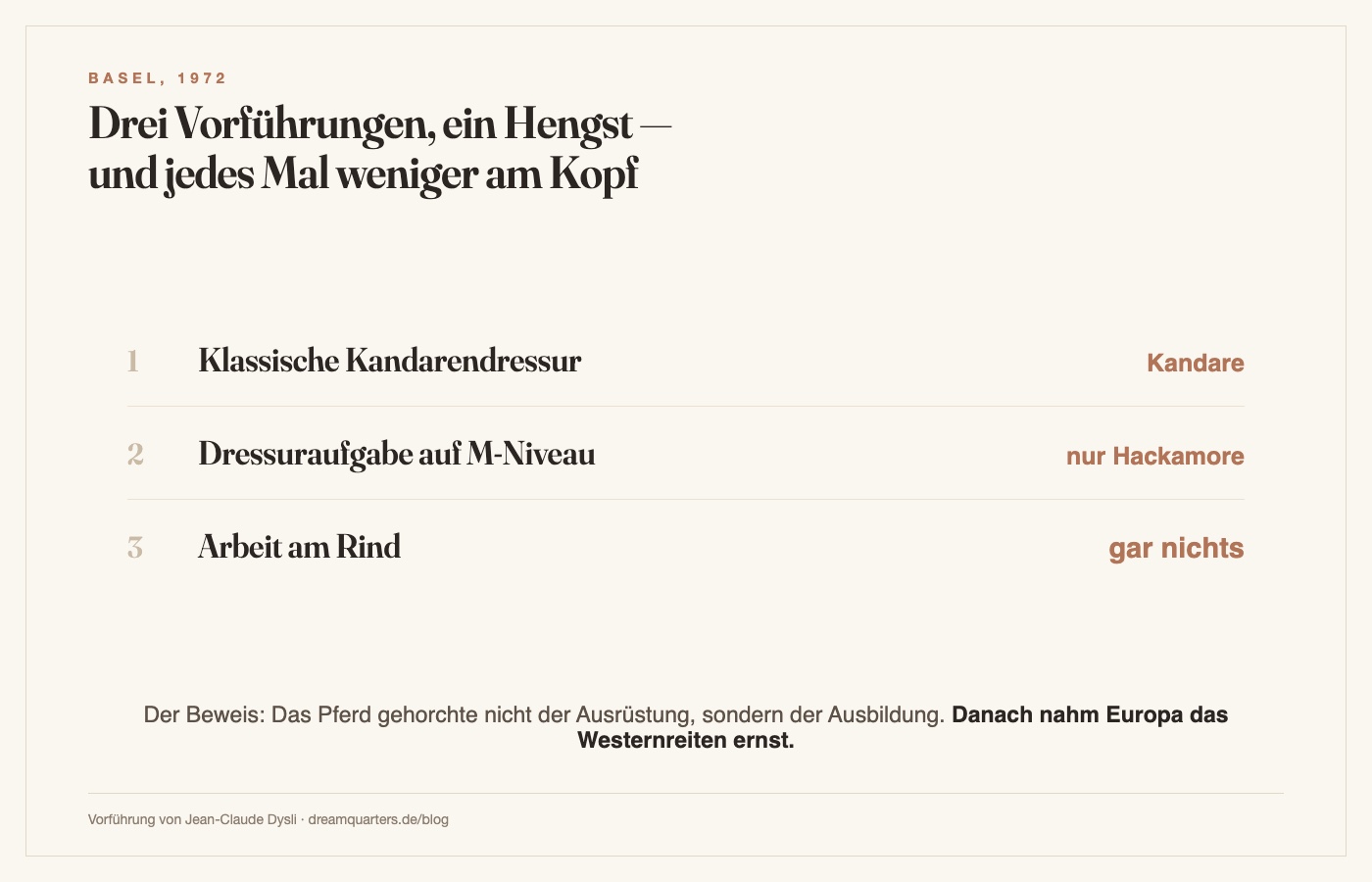
On May 25, 1964, Dysli loaded his first two Quarter Horses onto a ship bound for Switzerland; a dated photograph shows the stallion Navada Victory on deck. At first hardly anyone over here took him seriously — until a demonstration in Basel in 1972 that today we would call viral: on one and the same stallion he first showed classic Californian bridle work, then rode a medium-level dressage test in the bitless hackamore, and finally worked cattle with nothing on the horse's head at all. In 1975 he thrilled the Equitana crowds on his mustang Popcorn and, in the same year, sat on the founding board of the Deutsche Quarter Horse Association (DQHA). After the show he had a beer with dressage legend Reiner Klimke — and the two discovered they worked by the same classical principles, just in different saddles.
For five decades Dysli taught all over Europe; his triad of balance, feeling and timing still sits in countless clinic notebooks. In December 2013 his old stallion Okie Isma Dad died first. Seven days later Dysli's heart stopped too, at 78. You may call that a coincidence if you like.
From 35 riders to 61,000 starts
What the pioneers had set in motion organized itself remarkably fast. October 1977, Münchholzhausen near Wetzlar: the first show of the freshly founded EWU, with 35 riders starting in reining, short race, barrel race and pole bending. The Erste Westernreiter Union — christened, incidentally, as the "Europäische Westernpferde- und -Reiter Union"; the acronym survived the later renaming — was officially registered in 1978 and is today the largest western riding federation in Germany and Europe. In 2024 alone it counted more than 61,000 show starts. From 35 to 61,000 — that one curve holds the whole story.
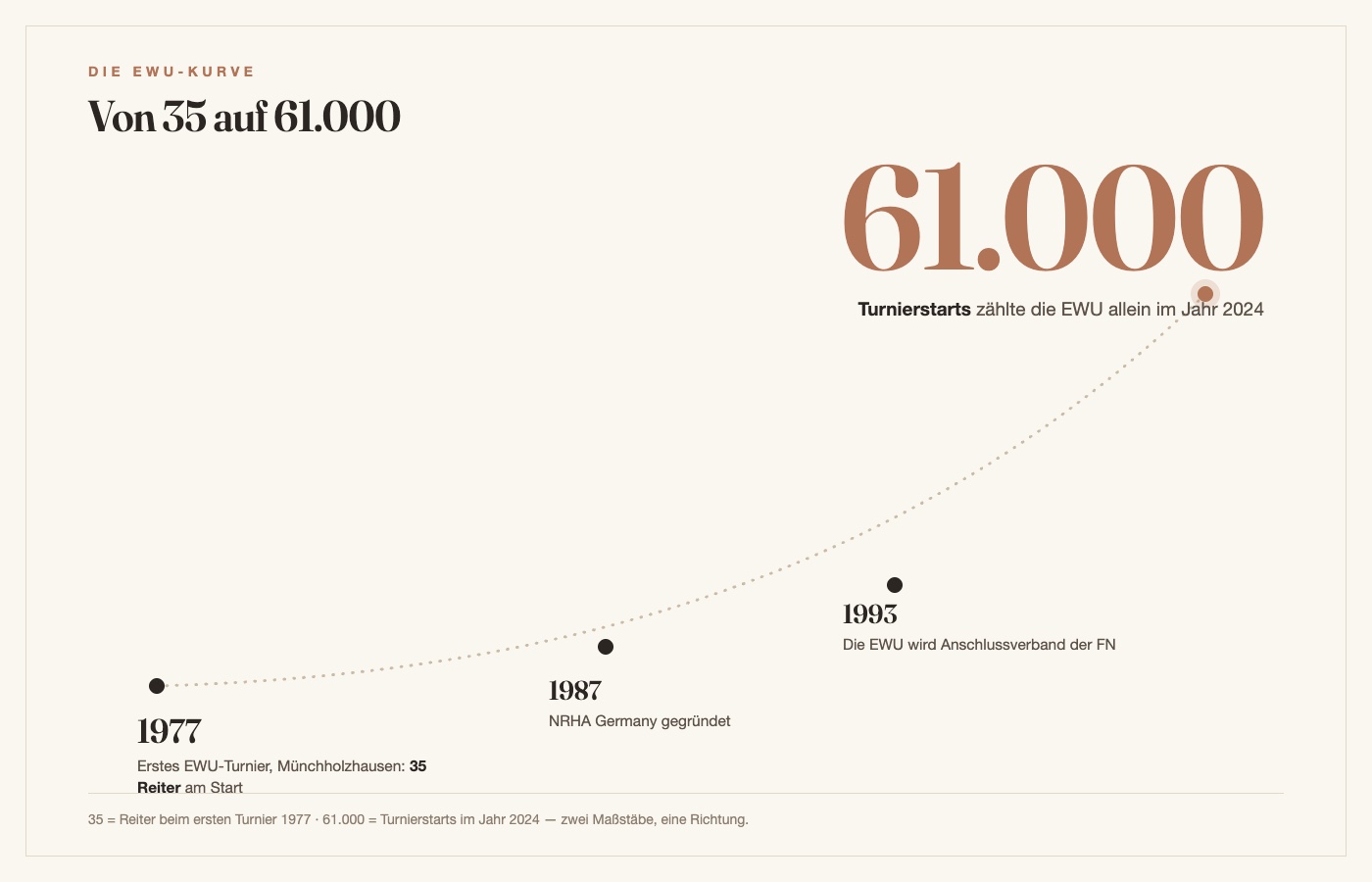
In 1987 NRHA Germany followed, today counting around 2,500 members, the second-largest reining federation in the world after its American parent. And the Americana? Its root is a western riding European championship held in 1979, of all places, in the Aachen Soers, the high temple of English riding. The name "Americana" was born in a phone call in 1985, the first edition ran in 1986 in Munich-Riem and drew 26,000 visitors straight away; from 1990 Augsburg became its home, and since 2023 it has been Friedrichshafen. One of its founding figures: Horst Geier — the same man who had chaired the young EWU as its first president eight years earlier. The European western scene was built by remarkably few, remarkably stubborn people.
The return flight: when Europe began to win
For a long time the old rule held anyway: the learning happens over there. The bar hung high — in the eighties its name was Bob Loomis, who won the Futurity six times, wrote the standard book on reining and owned a stallion he had bought before the horse was even born: Topsail Whiz, purchased in the womb of the mare Jeanie Whiz Bar, familiar to readers of our bloodlines article as the origin of the "Whiz" syllable. The unborn foal became the first twelve-million-dollar sire in NRHA history. Any European who was serious went to the States — like Grischa Ludwig, who trained under American pros and in 2000 rode an Americana victory all the way to third place in the NRHA's American year-end standings.
Then the wind turned. In 2007 the Austrian Rudi Kronsteiner became NRHA Open World Champion, with Grischa Ludwig as Reserve World Champion right behind him: the top of an American sport suddenly spoke German. Honesty demands the footnote that this world title is a year-end points race, collected at shows around the world — not the NRHA Futurity in Oklahoma City, the sport's biggest single event, which no rider based in Europe has won to this day. But the list kept growing anyway: Belgium's Ann Fonck became World Champion in 2014. Her husband Bernard took individual reining gold at the World Equestrian Games (WEG) in 2018, the first European to do so. Italy's Gennaro Lendi — FEI World Champion of 2016 — became a Million Dollar Rider in 2021 — the first Italian to earn the entire million on European soil. And Grischa Ludwig won individual and team gold at the 2019 European Championship in Givrins, Switzerland — a historic double for German reining.
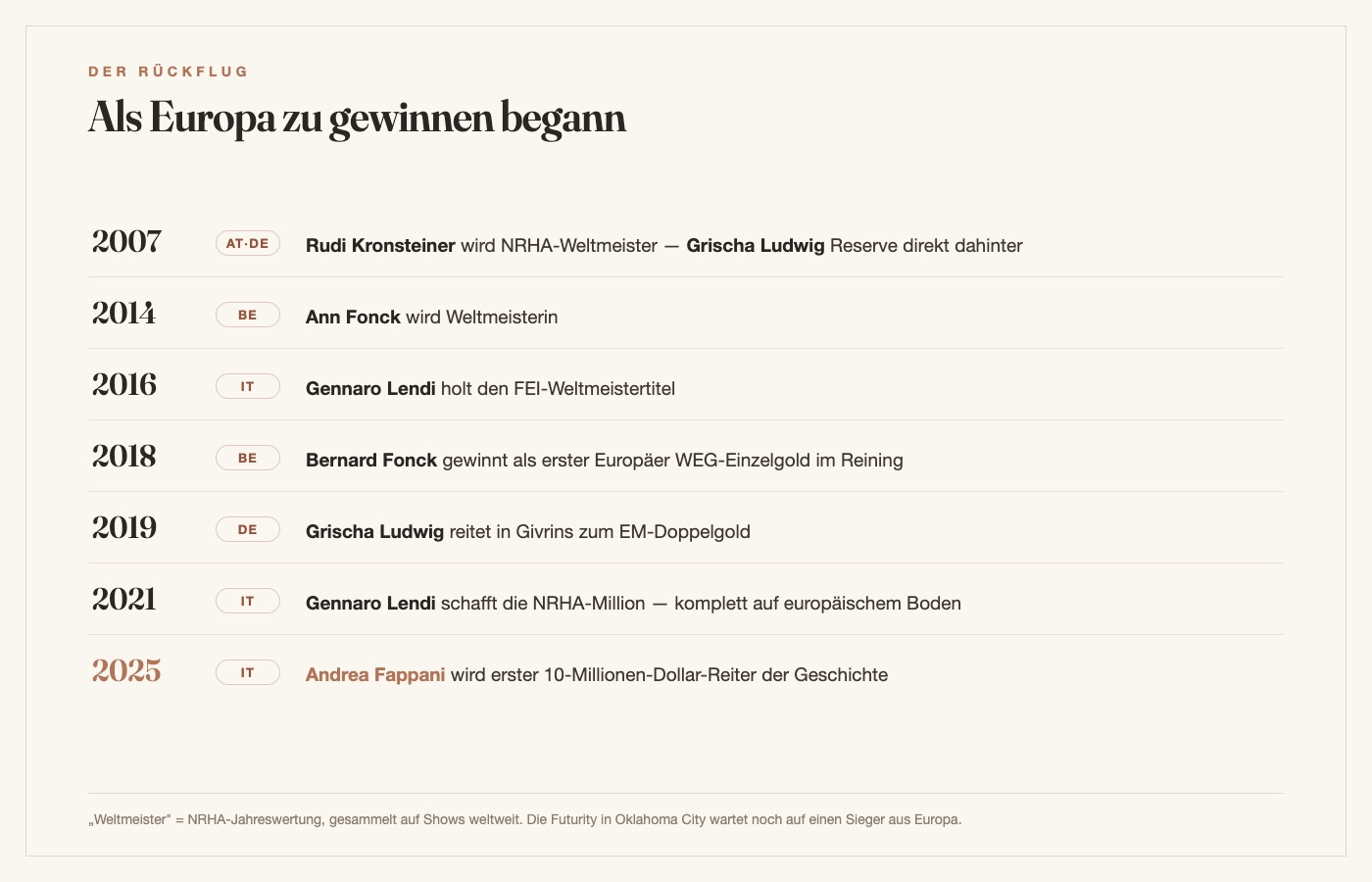
The punchline, though, comes from a dairy farm near Bergamo. That is where Andrea Fappani grew up, fourth generation, put on a horse as a toddler. In 1996 he won the Italian Futurity, then packed his bags and hired on in the States as an assistant. In 2001, aged 24, he became the first European ever to win the NRHA Futurity — decided in the first runoff in the history of the finals. In late 2021 he took over from Shawn Flarida as number one on the all-time money list — the Ohio man who holds the record with seven Futurity titles and who, in 2014, handed one of his five WEG gold medals to his little son right after the ceremony. And in December 2025 Fappani became the first rider in history to pass ten million dollars in earnings — on a finals night when his own son Luca stood on the scoreboard with him. The most successful western rider of all time is a European.
Western trainers today: the knowledge lives next door
Sixty years after the ship photograph, the import has become an education system. Today the EWU trains instructors under the education and examination rules of the German Equestrian Federation (FN), from Trainerassistent through Trainer C and B up to Trainer A Westernreiten — with a DOSB license and mandatory continuing education. What arrived on a ship's deck in 1964 and was passed around clinic barns is now taught with a curriculum. And the heirs of this line long ago left the trade-fair stage: they teach in arenas between the Baltic Sea and the Alps.
That is exactly what our trainer directory is for: western trainers from Bavaria to Brussels, with their disciplines, their story and a direct line — every trainer equal, nobody can pay their way to the top. What to look for when choosing is in our guide to finding a trainer; if you would rather start with a weekend, the clinic guide has you covered.
And if you are the one doing the teaching, this story is yours too. A coach profile on Dream Quarters costs €9 a month, and you list your courses and clinics in the western calendar for free. Dale Wilkinson taught for years without ever being on a payroll — it does not have to go quite that far. But his principle stands: good knowledge belongs where horses and people can find it.


