There is a show class in which hoof polish and a braided mane get you disqualified. In barely a decade it has gone from side experiment to the fastest-growing class in western sport, and its whole idea fits in one sentence: ride as if you were on your way to get something done. This is the honest guide to ranch riding — maneuvers, rules, scoring, and the question of which horse you actually need. Spoiler: probably yours.
What is ranch riding?
Ranch riding simulates what western horses were originally bred for: a day of work. You ride a pattern of all gaits with transitions, a stop, a back-up and a few extras like a side pass or poles — and what is judged is whether this horse would be useful on a ranch. Forward, on light contact, no drama. No cattle in the pen, no sliding plates, no specialist saddle. Just a horse that looks like it has a job — and a rider who interferes with it as little as possible.
The history is short and steep: its roots lie in the Versatility Ranch Horse program the AQHA launched in 2002; "ranch horse pleasure" debuted as a standalone class at the 2012 AQHA World Show, and since 2015 it has officially been called ranch riding. Then something happened that is rare in registry history: the class grew faster than any other and is now among the most popular at most AQHA shows. Europe followed — Germany's EWU added the discipline in 2015, DQHA shows run it under AQHA rules, and in 2022 the EWU made ranch riding the fourth discipline of its young-horse program, alongside basis, reining and trail. A federation cannot state more clearly: this one stays.
The dress code: glitter loses
The fastest way to understand ranch riding is its list of bans. At AQHA shows: hoof black — disqualified. Braided or banded manes — disqualified. Tail extensions — disqualified. Silver on saddle and bridle is allowed but, per the rulebook, explicitly not rewarded. Ranch riding is thus the only class in which the show styling of the neighbouring disciplines is a rule violation. The horse should look like it came from work, not from the hairdresser — working saddle, plain headstall, natural mane. For anyone who has ever stood at the hitching rail at six in the morning with banding elastics, this is either culture shock or salvation.
The pattern, maneuver by maneuver
Mandatory are walk, trot and lope on both leads, plus extended gaits — at minimum an extended trot and extended lope —, a stop and a back-up. Depending on the pattern there are side passes, turns, pole work and a simple or flying lead change. Sounds like a dressage test in a western saddle, and that is not entirely wrong — only the breeding goal differs: working horse, not ballerina.
The centrepiece is the extended trot — the maneuver this discipline was invented for. Ground-covering, over the back, often ridden in a light forward seat: the moment you see whether a horse truly thinks forward or merely moves its legs faster. Watch one good extended trot across the arena and the boom of this class needs no further explanation.
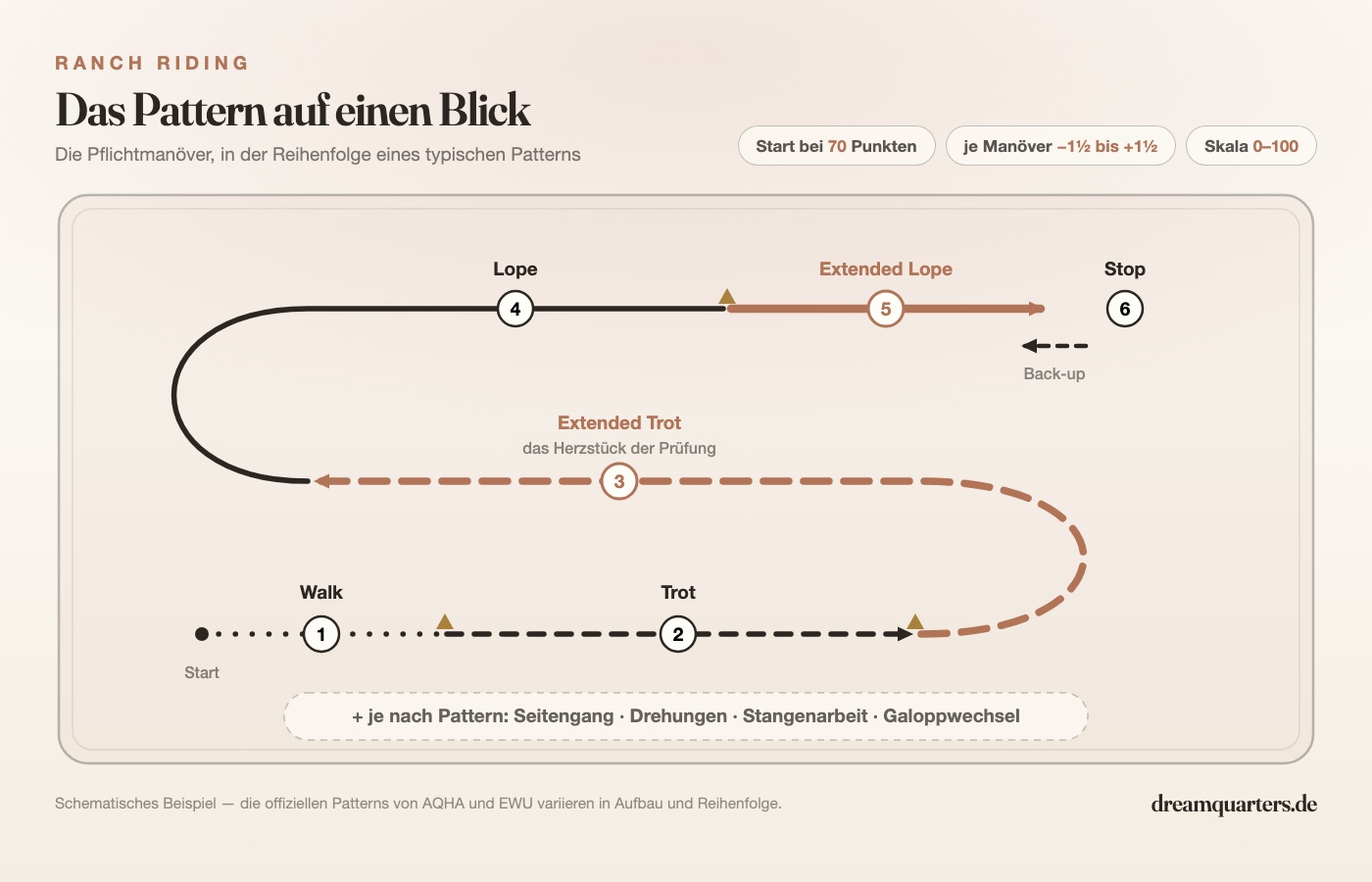
Scoring works like reining: every run starts at 70 points, each maneuver is graded from −1½ to +1½, the scale runs from 0 to 100. Rewarded is what looks willing, natural and purposeful — a horse "with a destination and a finishing time". Penalised are artificial slowness, a head forced too low, and anything that reads as tension rather than work. What other classes want costs points here — not because it is worse, but because the goal is different.
Why the class is exploding
Three honest reasons. First: entry costs almost nothing extra. You need your horse, your saddle, your bridle and tidy western attire — no show wardrobe, no second saddle with silver trim, no special shoeing. Second: the picture is horse-friendly. Natural self-carriage, honest gaits, forward riding — exactly the direction judges and federations are pushing the sport. Third, and this is the real engine: every type of horse may enter. The reiner, the all-rounder, the well-ridden leisure horse — they can all enter the same pattern. Everyone can take part. Winning is another chapter, and it comes now.
Which horse can do ranch riding?
To get started: yours. If it walks, trots and lopes with a clear rhythm, has solid basic training and can extend without falling apart, you can enter — precisely this low threshold makes the class the best first show for western riders. What a well-trained western horse looks like is covered in our guide to learning western riding.
At the top it gets more specific, and here comes the discipline's plot twist: reining bloodlines dominate. Names like Gunnatrashya, Spooks Gotta Gun, Lil Joe Cash or Magnum Chic Dream appear in the papers of world champions remarkably often — no accident, since reining breeders have selected for rideability, self-carriage and cool minds for decades. Exactly the ingredients a ranch riding pattern rewards. Cow blood like Woody Be Tuff adds size and expression to the field. The US market has long priced this in: in 2024, a young ranch riding prospect sold for 177,000 dollars.
For everyday use your horse needs none of those names in its papers. But if you want to buy or breed deliberately, start with the bloodline guide, then the stallion directory — where stallions with exactly this reining and all-round blood stand in Europe — and the breeders who raise such horses. And yes, the class has a visible soft spot for duns and buckskins; why those colours work like that is told in the colour guide. The old rule still applies: colour doesn't ride.
Learning ranch riding: the fastest route
The discipline looks like relaxed trail riding indoors — which is exactly why it gets underestimated. Clean transitions are half your score, and you don't ride transitions well by accident. The fastest route is a trainer who knows the class: the trainer directory lists coaches by region, many offer courses and clinics where a complete pattern is built up. What to look for when choosing is in the guide to finding a western trainer. After that you can enter EWU shows and DQHA/AQHA shows — rulebooks are at the AQHA and the EWU.
Buying a ranch riding horse
Honesty first: hardly any listing is headlined "ranch riding horse". The candidates stand in the market as all-rounders and reining-bred horses — you have to read them. The order when visiting: first the trot (does it extend without losing rhythm and balance?), then the throughness in transitions, then the mind — a ranch riding horse may think along, but not argue along. And as always, the pre-purchase exam decides in the end, not the sales video. What such a horse should cost overall, including running costs, is calculated in What does a western horse cost?.
You can search right away: all current sale horses — every listing equal, sorting random by default — or on the map if you want to know what stands within reach of your yard.
Is ranch riding right for you?
- You want to show without acquiring a second horse, a show saddle and a glitter budget.
- You think a horse should look like a horse — and riding should look like going somewhere, not posing.
- Your horse has a proper trot and you have always wanted to be officially rewarded for riding forward across the arena.
- Your relationship with hoof polish was never particularly close anyway.
If you nodded three times: welcome to the discipline with the lowest entry barrier and the most honest look in western sport. The pattern is waiting — and if the right horse is still missing, it may already be standing here.